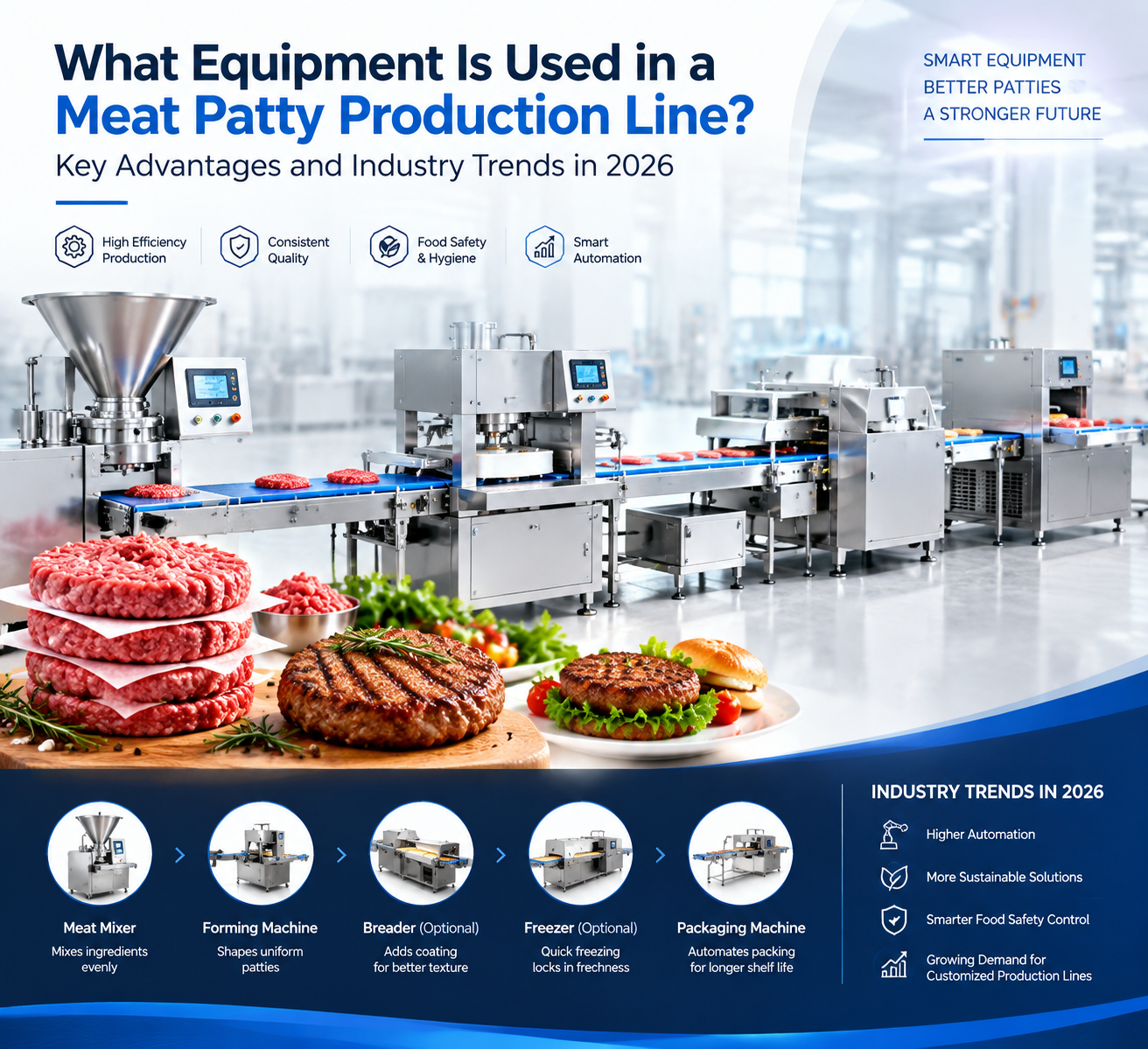
What Equipment Is Used in a Meat Patty Production Line? Key Advantages and Industry Trends in 2026
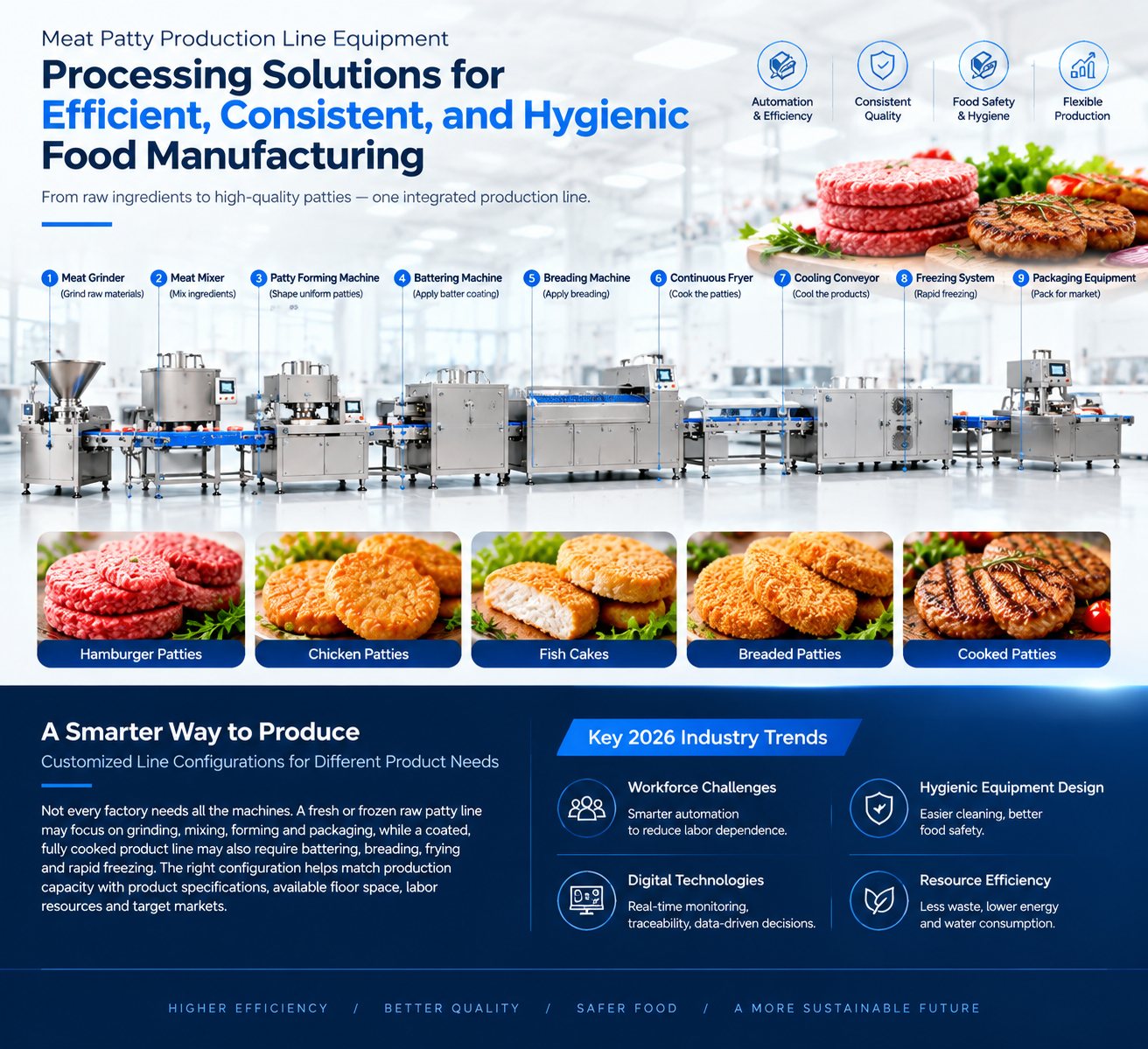
Meat Patty Production Line Equipment: Processing Solutions for Efficient, Consistent, and Hygienic Food Manufacturing
The global food processing industry is increasingly focused on automation, production consistency, food safety, and flexible manufacturing. According to the 2026 Processing State of the Industry report from PMMI and FPSA, workforce challenges, hygienic equipment design, digital technologies, and resource efficiency are important priorities for food processors. These trends are directly relevant to manufacturers producing hamburger patties, chicken patties, fish cakes, and other formed protein products. A meat patty production line integrates multiple machines to transform prepared ingredients into uniformly shaped products ready for cooking, freezing, or packaging. Depending on the recipe and production requirements, the main equipment may include an industrial meat grinder, meat mixer, automatic meat patty forming machine, battering machine, breading machine, continuous fryer, cooling conveyor, freezing system, and packaging equipment. Not every factory needs all these machines: a fresh or frozen raw patty line may focus on grinding, mixing, forming, and packaging, while a coated, fully cooked product line may also require battering, breading, frying, and rapid freezing. Choosing the right configuration helps manufacturers match production capacity with product specifications, available floor space, labor resources, and target markets.
What Equipment Does a Meat Patty Processing Line Include?
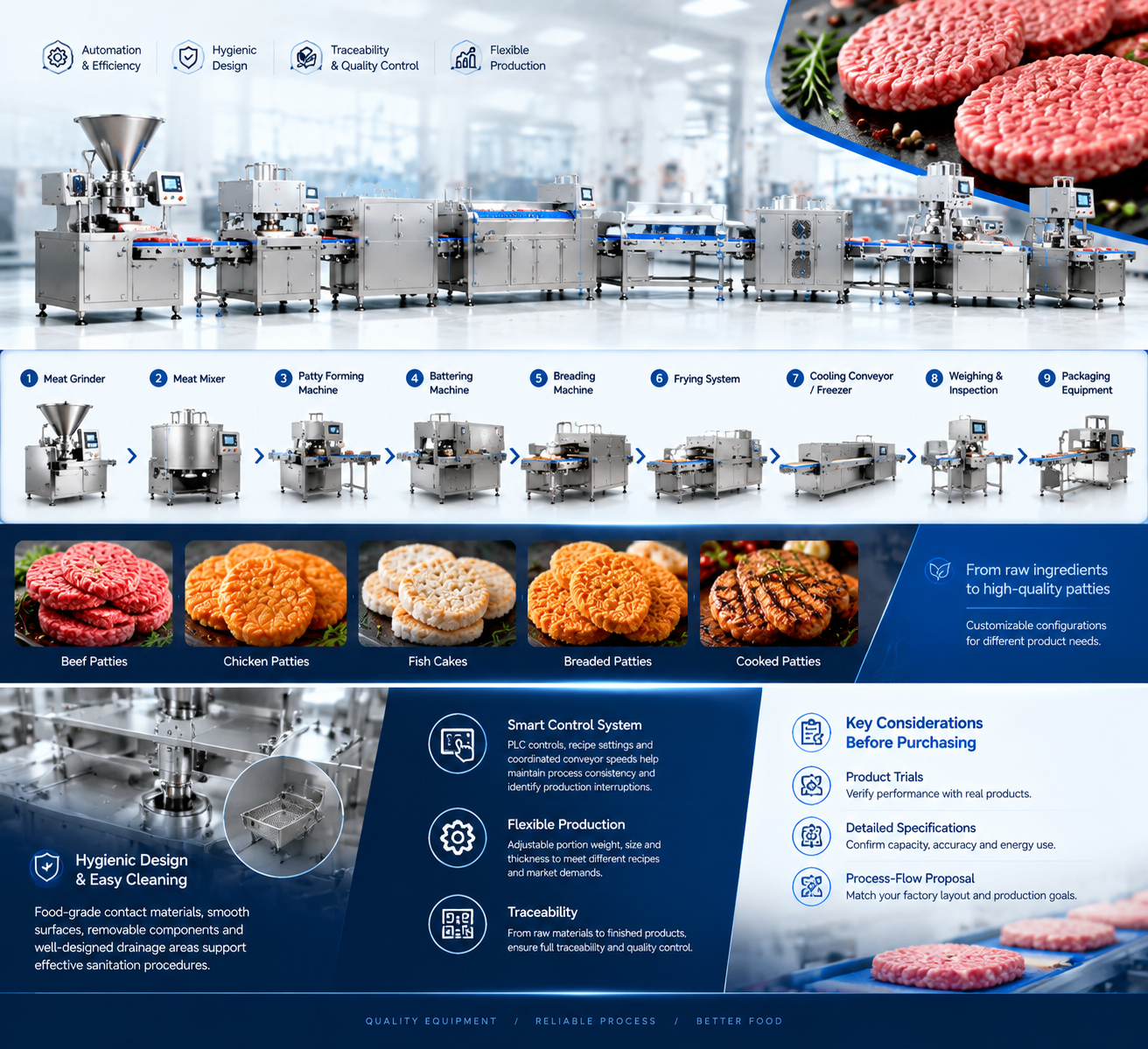
A complete automatic meat patty processing line typically begins with raw material preparation. An industrial meat grinder reduces chilled or suitable frozen meat to the required particle size, while a meat mixer blends the minced meat with seasonings and other recipe ingredients to achieve a more uniform mixture. The automatic patty forming machine then portions and shapes the mixture into patties with adjustable dimensions, thickness, and target weight, depending on the machine model and product recipe. For breaded products, a battering machine and breading machine apply coating layers before a continuous fryer or other cooking system processes the patties. A cooling conveyor, spiral freezer, or tunnel freezer may be added according to the required product temperature and production volume, followed by weighing, inspection, and packaging equipment. Modern purchasing decisions increasingly emphasize automation, hygienic design, traceability, and flexible production rather than machine speed alone. Food-grade contact materials, easy-to-clean structures, removable product-contact components, and well-designed drainage areas can support effective sanitation procedures. PLC controls, recipe settings, and coordinated conveyor speeds can help operators maintain process consistency and identify production interruptions. However, actual capacity, portion-weight accuracy, energy consumption, and cleaning time depend on the equipment model, raw material characteristics, product formulation, and factory operating conditions. Buyers should therefore request product trials, detailed specifications, and a complete process-flow proposal before selecting a supplier.
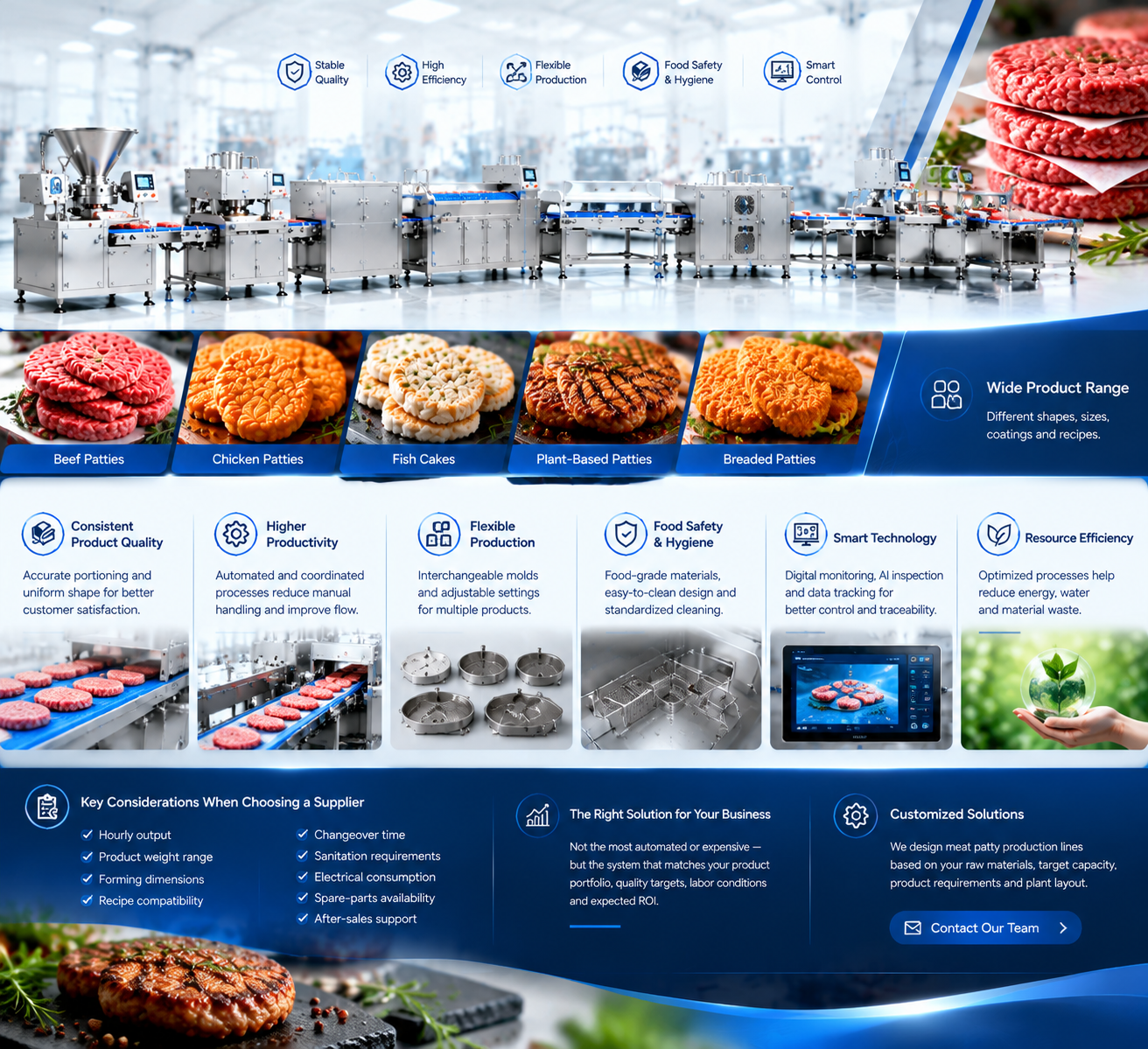
Compared with disconnected equipment or labor-intensive manual processing, a properly configured industrial meat patty production line can offer several practical advantages. First, automated forming improves repeatability in patty shape, thickness, and portion size, helping manufacturers meet customer specifications and manage ingredient usage. Second, coordinated equipment reduces unnecessary manual handling and can improve production flow, particularly for factories supplying supermarkets, restaurant chains, catering companies, and frozen food distributors. Third, interchangeable forming molds and adjustable operating settings may allow one line to produce different shapes and sizes, while optional coating, frying, freezing, and packaging modules expand the product range. Fourth, hygienic equipment design and standardized cleaning procedures can support food safety management, although machinery alone cannot guarantee compliance or prevent contamination. In 2026, flexible automation, digital process monitoring, AI-assisted inspection, and improved resource efficiency are increasingly important topics in food manufacturing; processors should evaluate these technologies according to measurable business needs rather than marketing claims. When comparing suppliers, assess hourly output, product weight range, forming dimensions, recipe compatibility, changeover time, sanitation requirements, electrical consumption, spare-parts availability, and after-sales support. Ask whether the quoted capacity refers to the forming machine or the complete line, and confirm whether downstream cooking and freezing equipment can maintain the same throughput. The best solution is not necessarily the most automated or expensive one, but the system that matches your product portfolio, quality targets, labor conditions, and expected return on investment. If you are planning a new facility or upgrading an existing factory, a customized meat patty production line can be designed around your raw materials, target capacity, finished-product requirements, and available plant layout. Contact our team to discuss your application and request a suitable equipment configuration and quotation.