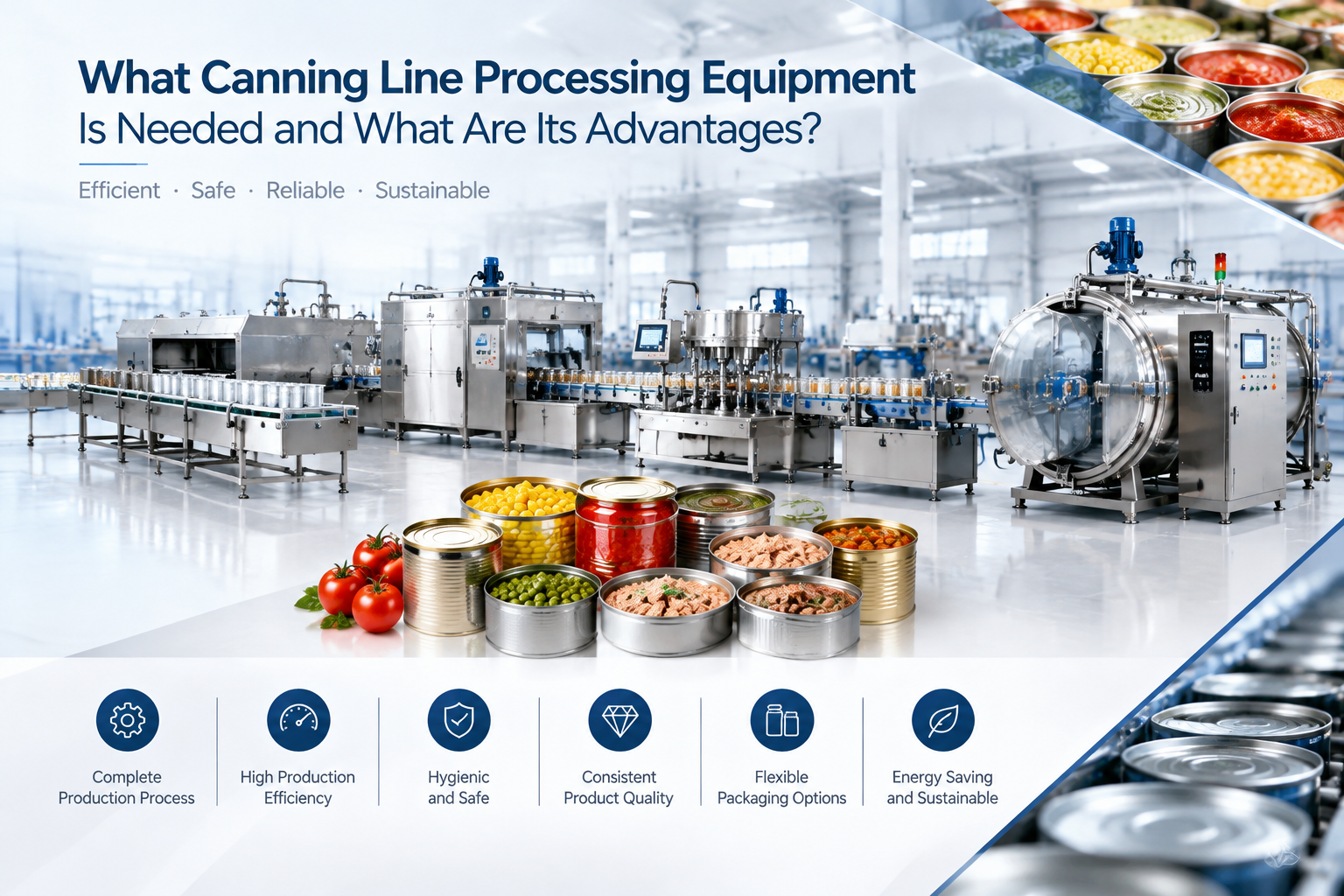
What Canning Line Processing Equipment Is Needed and What Are Its Advantages?
1. What Equipment Is Included in a Canning Production Line?
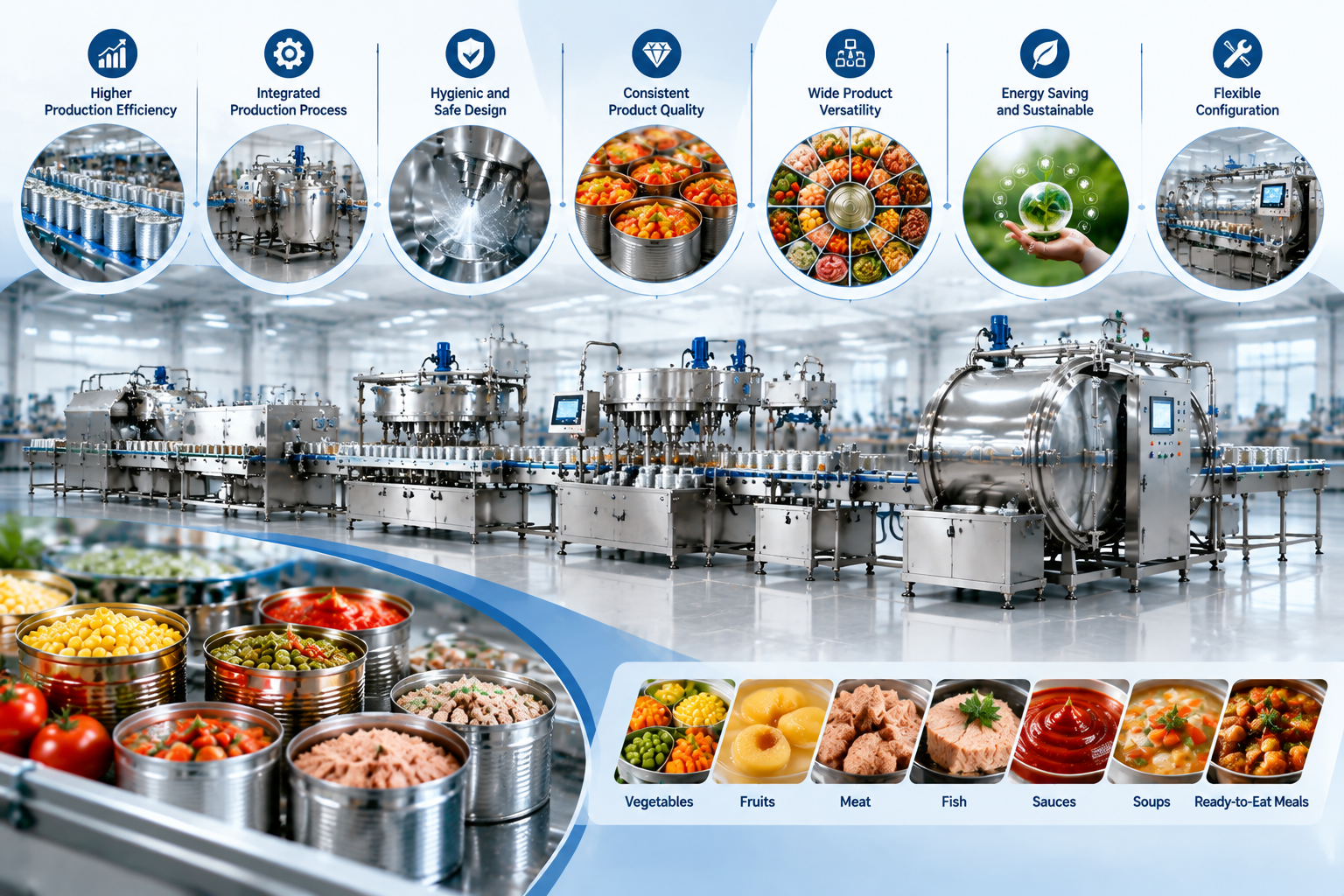
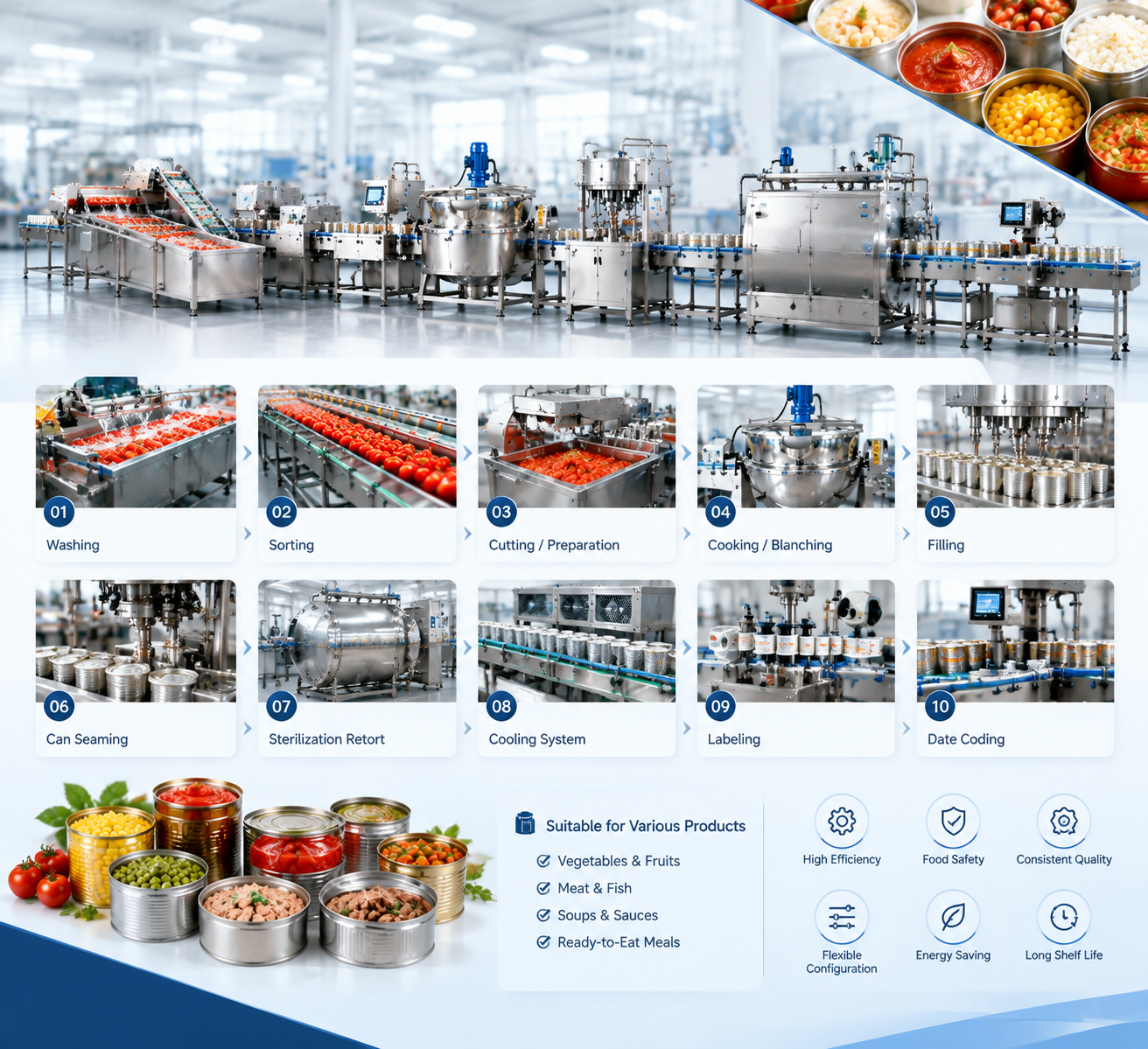
A complete Canning Production Line consists of a series of food processing and packaging machines designed to prepare, fill, seal, and preserve food in cans or other suitable containers. The exact equipment configuration depends on the product, packaging material, production capacity, and required shelf life. Common Canning Line Processing Equipment includes a food washing machine, sorting conveyor, cutting or preparation machine, cooking kettle or blanching machine, filling machine, can seaming machine, sterilization retort, cooling system, labeling machine, and date coding equipment. For canned vegetables and fruits, washing, sorting, cutting, filling, and thermal processing are important stages. For canned meat, fish, and prepared meals, additional cooking, portioning, or product handling equipment may be required. The can filling machine places the prepared food into containers, while the can seaming machine creates a secure hermetic closure. Depending on the food formulation and packaging method, a retort sterilizer or another validated thermal processing system may be necessary to achieve the required food safety and shelf stability. Manufacturers should select equipment based on the actual product, can dimensions, target output, and applicable destination-market regulations rather than assuming that every product requires the same production process.
2. What Are the Main Advantages of Modern Canning Processing Equipment?
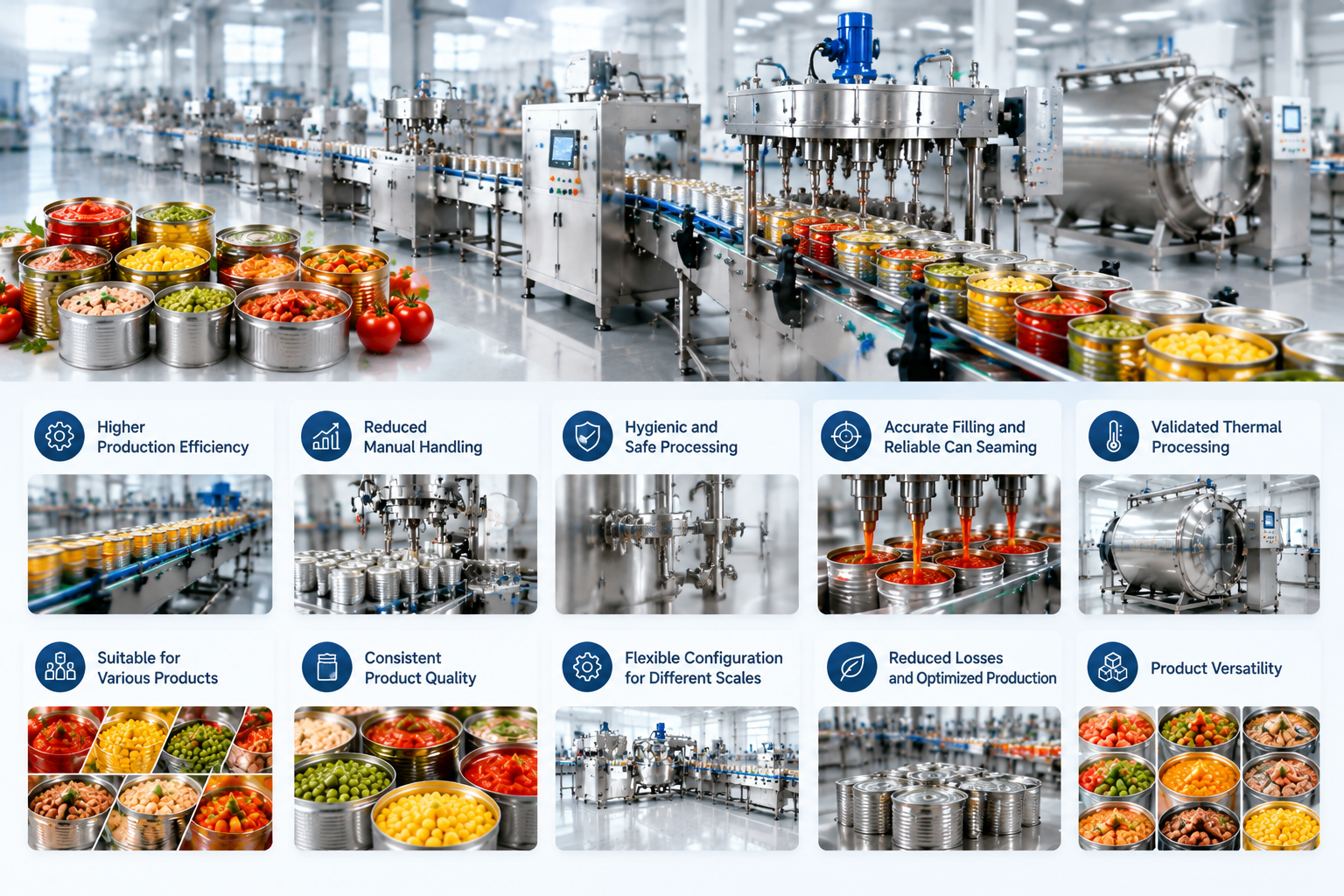
Modern Canning Processing Equipment offers several advantages for food manufacturers seeking stable production, consistent product quality, and improved operational efficiency. First, integrated equipment can reduce unnecessary manual handling and connect preparation, filling, sealing, and thermal processing into a more organized workflow. Semi-automatic systems can be suitable for small and medium-sized food factories, while automated canning lines can help larger manufacturers increase throughput and reduce dependence on repetitive manual work. Second, hygienic equipment design, accessible cleaning areas, suitable food-contact materials, and effective process monitoring support sanitation management and help manufacturers control contamination risks. Third, accurate filling and reliable can seaming help maintain consistent portion sizes and package integrity, while validated thermal processing is essential for products requiring commercial shelf stability. Another important advantage is product versatility: appropriately configured canning equipment can process vegetables, fruits, beans, soups, sauces, meat, fish, and ready-to-eat meals. Equipment selection must still account for differences in viscosity, particle size, acidity, heat transfer, and packaging format. For low-acid canned foods, thermal processing conditions must be established and validated for the specific product and container by qualified specialists; a machine's rated capacity alone does not guarantee food safety. By matching equipment capacity and processing parameters to the product, manufacturers can improve production planning, reduce avoidable losses, and maintain more consistent manufacturing standards.
3. Canning Line Trends in 2026: Automation, Food Safety, and Sustainable Production
In 2026, Canning Production Line development is increasingly influenced by automation, hygienic design, production flexibility, and resource efficiency. PMMI and FPSA's 2026 industry reporting identifies workforce challenges, food safety, digital tools, and sustainability as important factors shaping investment in food and beverage processing equipment. Manufacturers are therefore evaluating more integrated production systems, user-friendly control interfaces, process monitoring, and inspection technologies that help operators identify deviations and improve production visibility. AI-assisted inspection and data-driven maintenance are emerging applications, although their suitability depends on the factory's production scale, available data, and expected return on investment. Sustainability is another key consideration: efficient heating, optimized water use, reduced product waste, and well-planned cleaning procedures can help control operating costs. Packaging flexibility also matters as food producers evaluate metal cans, glass jars, and suitable alternative packaging formats for different products and markets. However, changing a container type may require different filling, sealing, handling, and thermal processing arrangements. For businesses planning a new Canning Line Processing Equipment investment, the best approach is to define the product range, target capacity, packaging specifications, required shelf life, and destination-market requirements before selecting individual machines. A properly matched canning line can provide a practical foundation for reliable food production, consistent packaging quality, and long-term business development.