
Peanut butter production line
Automatic Peanut Butter Production Line: Advantages and Future Trends
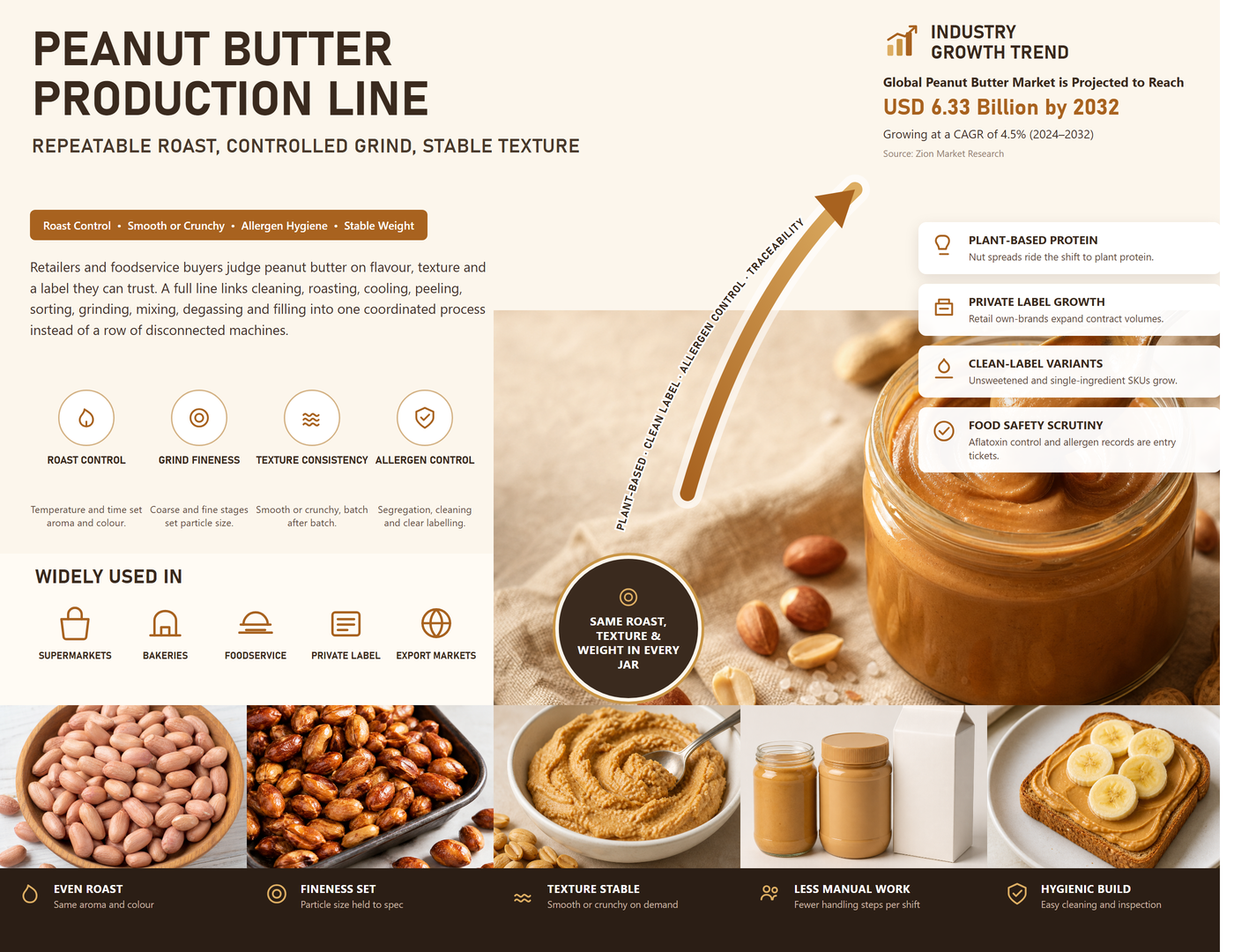
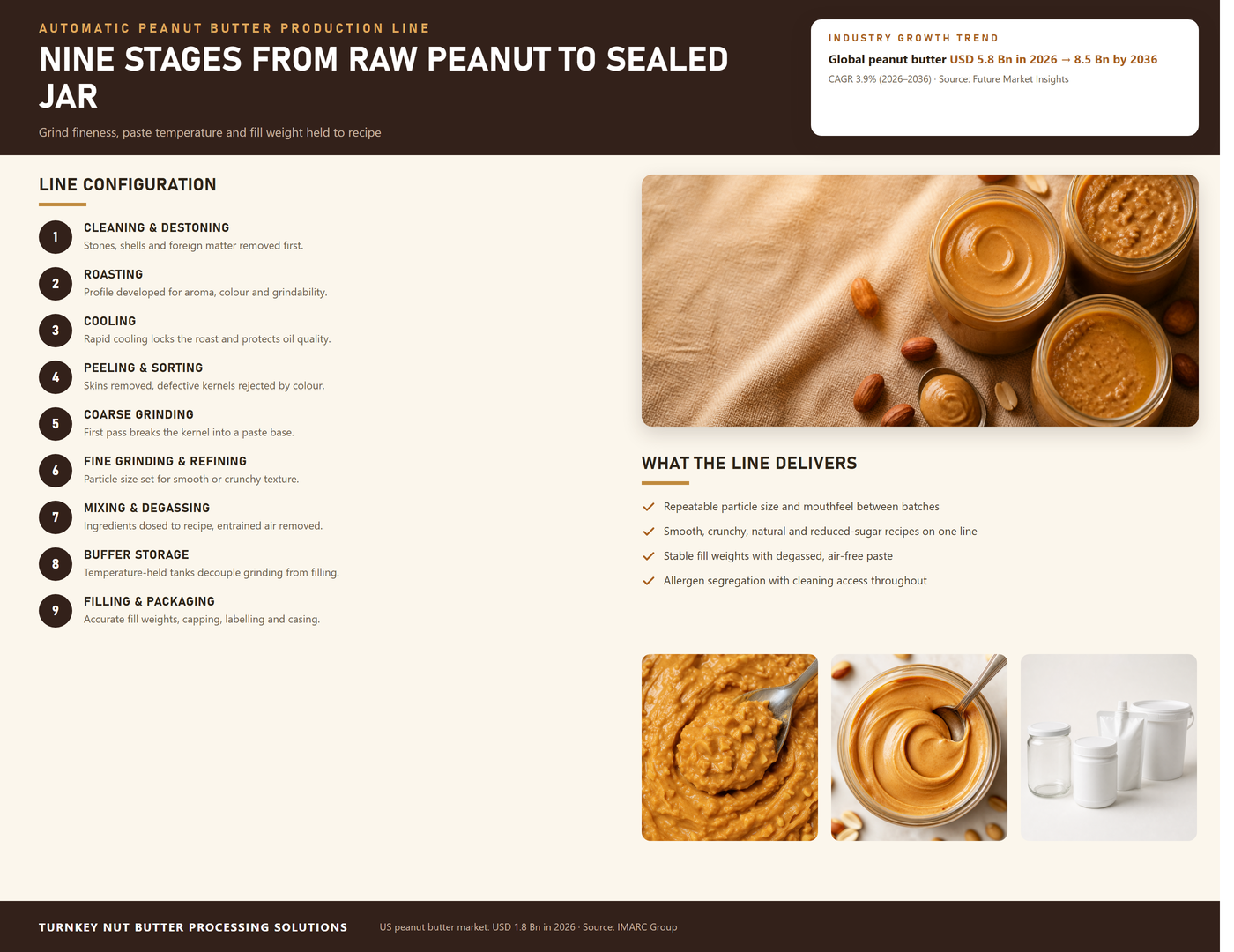
With the growing demand for convenient foods, plant-based ingredients, protein-rich snacks, and versatile spreads, peanut butter continues to offer opportunities for food manufacturers, ingredient suppliers, supermarkets, and private-label brands. Consumers are looking for a wider range of products, including smooth peanut butter, crunchy peanut butter, natural peanut butter, reduced-sugar formulations, and flavored nut spreads. These changing preferences are encouraging manufacturers to improve product consistency, develop new recipes, and strengthen production efficiency. An automatic peanut butter production line provides an integrated solution for transforming raw or roasted peanuts into finished peanut butter through coordinated processing stages such as peanut cleaning, roasting, cooling, peeling, grinding, mixing, refining, storage, filling, and packaging. The exact configuration depends on the raw materials, product texture, required capacity, and packaging format. For example, smooth peanut butter requires suitable grinding and refining performance, while crunchy peanut butter may need additional equipment to incorporate controlled peanut pieces. Natural formulations may require different handling and mixing considerations to manage oil separation and maintain the desired texture. Modern food processing increasingly emphasizes automation, hygienic design, flexible production, and improved process monitoring as manufacturers seek to manage labor costs and meet higher quality expectations. For peanut butter manufacturers, an integrated processing line can help coordinate individual machines, reduce unnecessary manual handling, and establish a more repeatable production workflow. It can also support the development of different package sizes for retail, foodservice, baking, confectionery, and industrial ingredient applications. By selecting equipment that matches their product portfolio and production goals, manufacturers can build a scalable peanut butter manufacturing system that responds to changing consumer preferences and creates opportunities in both domestic and international markets.
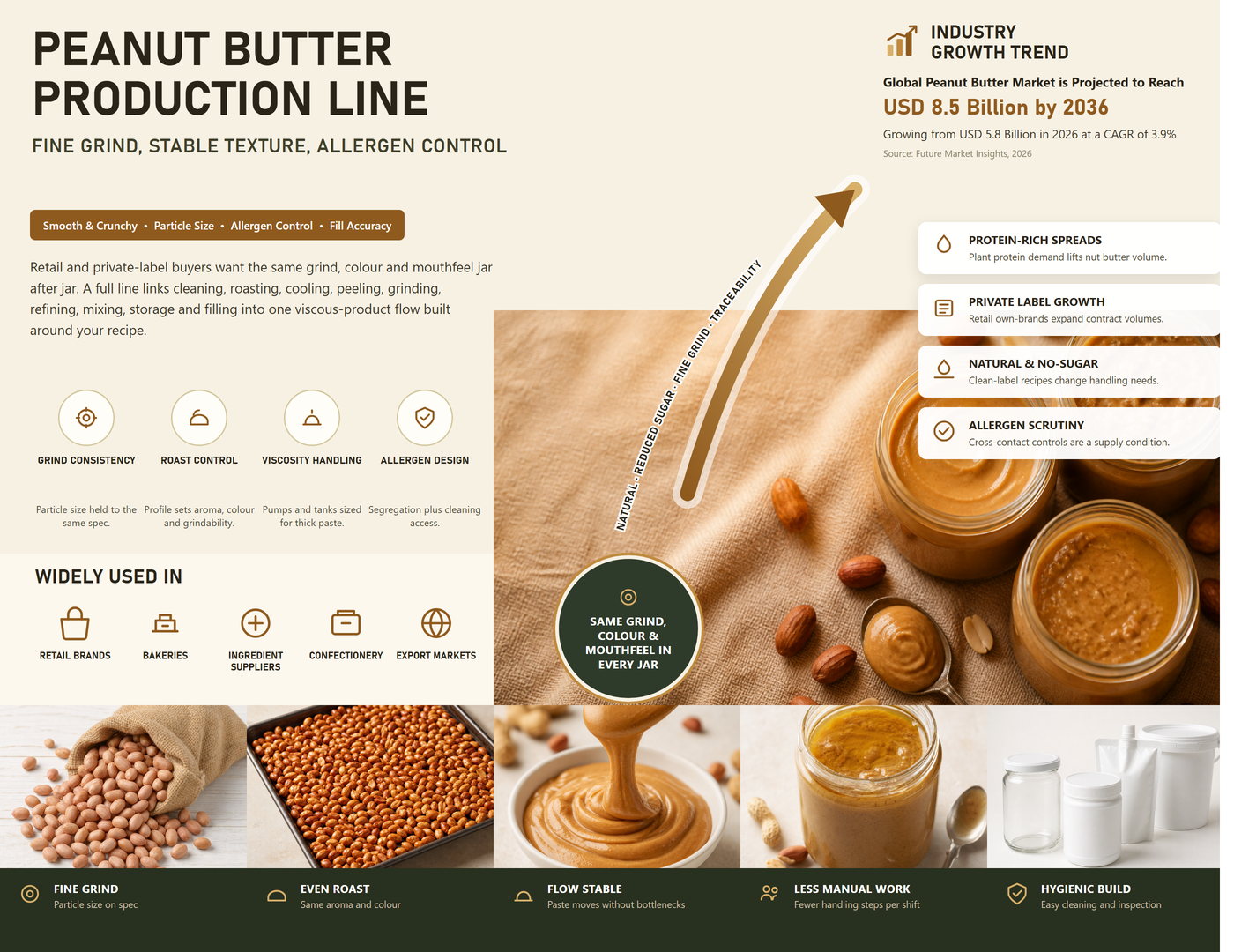
One of the key advantages of an industrial peanut butter production line is its ability to improve grinding consistency, production efficiency, and finished-product quality. In a poorly coordinated process, variations in roasting conditions, peanut moisture, grinding temperature, particle size, mixing, and filling can affect flavor, texture, viscosity, and product appearance. Suitable roasting and cooling equipment helps prepare peanuts for subsequent processing, while peeling and sorting systems can help remove unwanted material according to production requirements. Industrial peanut butter grinding machines then reduce the peanuts to the required particle size and texture, with additional refining or mixing equipment available when a smoother or more uniform product is needed. Properly selected pumps, storage tanks, and filling machines can help maintain a stable workflow between processing and packaging. Automation can reduce repetitive manual work, improve throughput, and support more consistent batch-to-batch results. Accurate filling and weight control may also help reduce product giveaway and improve packaging efficiency. However, actual capacity, texture, energy consumption, and cost savings depend on the equipment configuration, peanut characteristics, recipe, and operating conditions. Food safety is especially important in peanut butter production because peanuts are a major allergen and may present microbiological risks if raw materials and processing are not properly controlled. Manufacturers need suitable supplier approval, raw-material inspection, validated roasting or other relevant control measures, hygienic equipment design, effective cleaning procedures, allergen cross-contact prevention, and appropriate environmental and finished-product testing. Food-contact components should be made from suitable materials, and the line should provide practical access for inspection and maintenance. Because peanut butter is a high-viscosity product, equipment must also be selected to handle the required flow characteristics without creating unnecessary processing bottlenecks. Natural peanut butter and other formulations may behave differently during storage, so product stability, oil separation, packaging compatibility, and shelf-life conditions should be assessed through appropriate testing. Modern production lines can incorporate PLC controls, touchscreen operation, temperature monitoring, and production records to support repeatable processing and traceability. These functions help manufacturers establish stronger quality management while maintaining the flexibility to produce different peanut butter varieties.
Looking ahead, peanut butter manufacturing is increasingly shaped by flexible production, digital monitoring, food safety, energy efficiency, and more responsible resource utilization. These developments are relevant to peanut butter factories seeking to increase output while maintaining dependable product quality and controlling operating costs. A modern peanut butter processing line can be designed with automatic feeding, adjustable grinding settings, programmable controls, filling-volume adjustment, and optional production data monitoring. More advanced facilities may consider condition monitoring or predictive maintenance tools to help identify abnormal machine performance and reduce unexpected downtime. Such digital features should support, rather than replace, validated food safety procedures and operator oversight. Sustainability can also be addressed through efficient motors, suitable heating systems, optimized roasting conditions, reduced product losses, and cleaning procedures designed around actual hygiene requirements. For small and medium-sized businesses, modular peanut butter production equipment can provide a practical path toward automation, allowing capacity to expand as sales grow. Larger factories may benefit from integrated systems connecting raw-material preparation, roasting, grinding, refining, filling, and packaging. When selecting a peanut butter production line manufacturer, buyers should evaluate processing capacity, smooth and crunchy product capability, target particle size, temperature control, allergen-management requirements, cleaning accessibility, energy consumption, maintenance needs, spare-parts availability, installation guidance, and after-sales technical support. It is also important to confirm the expected output using representative raw materials and the intended finished-product specifications. A well-designed solution should consider the complete manufacturing process rather than focusing on the grinding machine alone. By combining appropriate equipment with reliable process controls and effective food safety management, peanut butter manufacturers can improve production efficiency, maintain more consistent texture, develop new product varieties, and strengthen their competitiveness in the global food processing market.
Mobile: +86 15094949111
WhatsApp: +86 15094949111
Skype: +86 15094949111
WeChat: +86 15094949111
Email: caroline@zekomachinery.com