
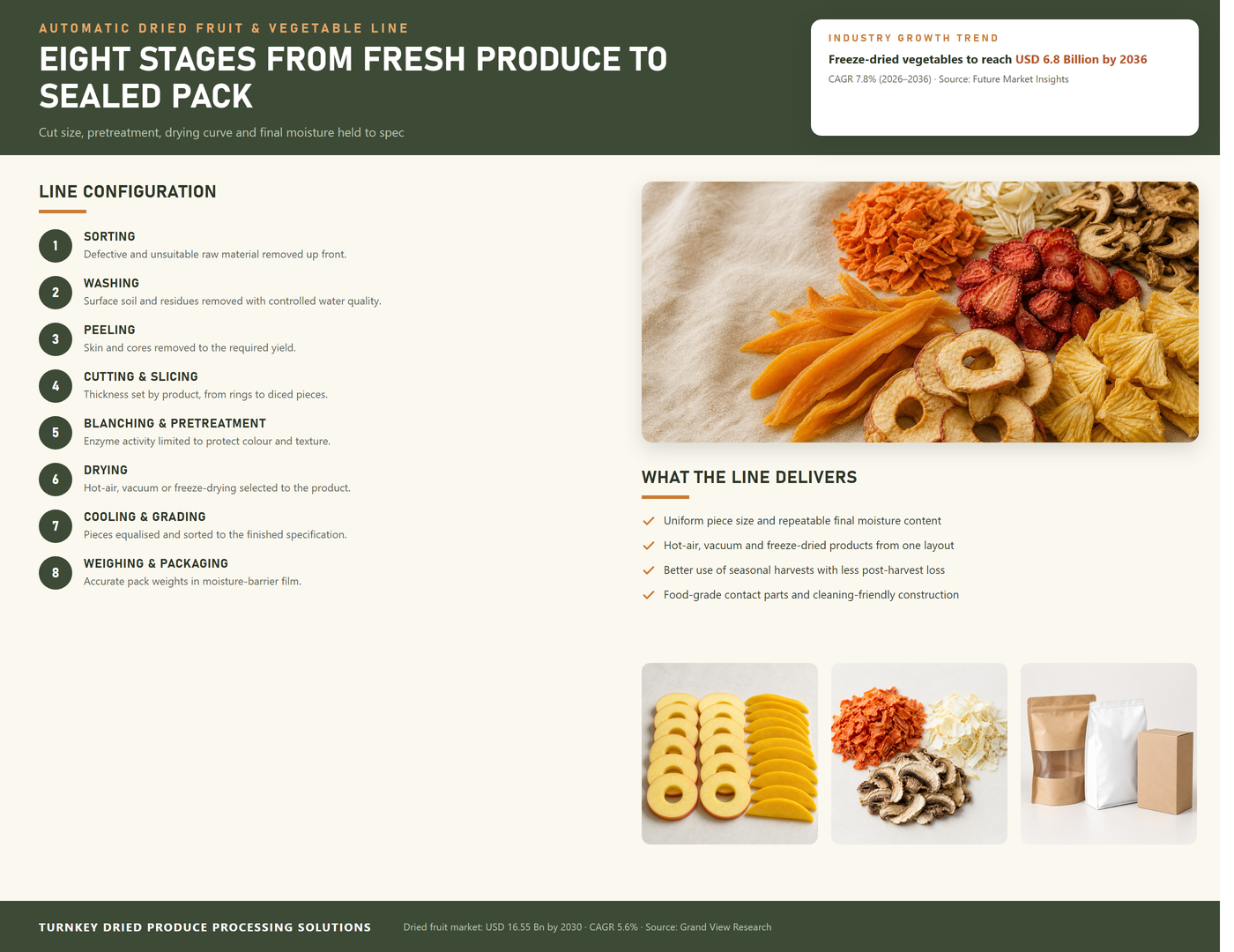
Dried fruit and vegetable production line
Automatic Dried Fruit and Vegetable Production Line: Advantages and Industry Trends
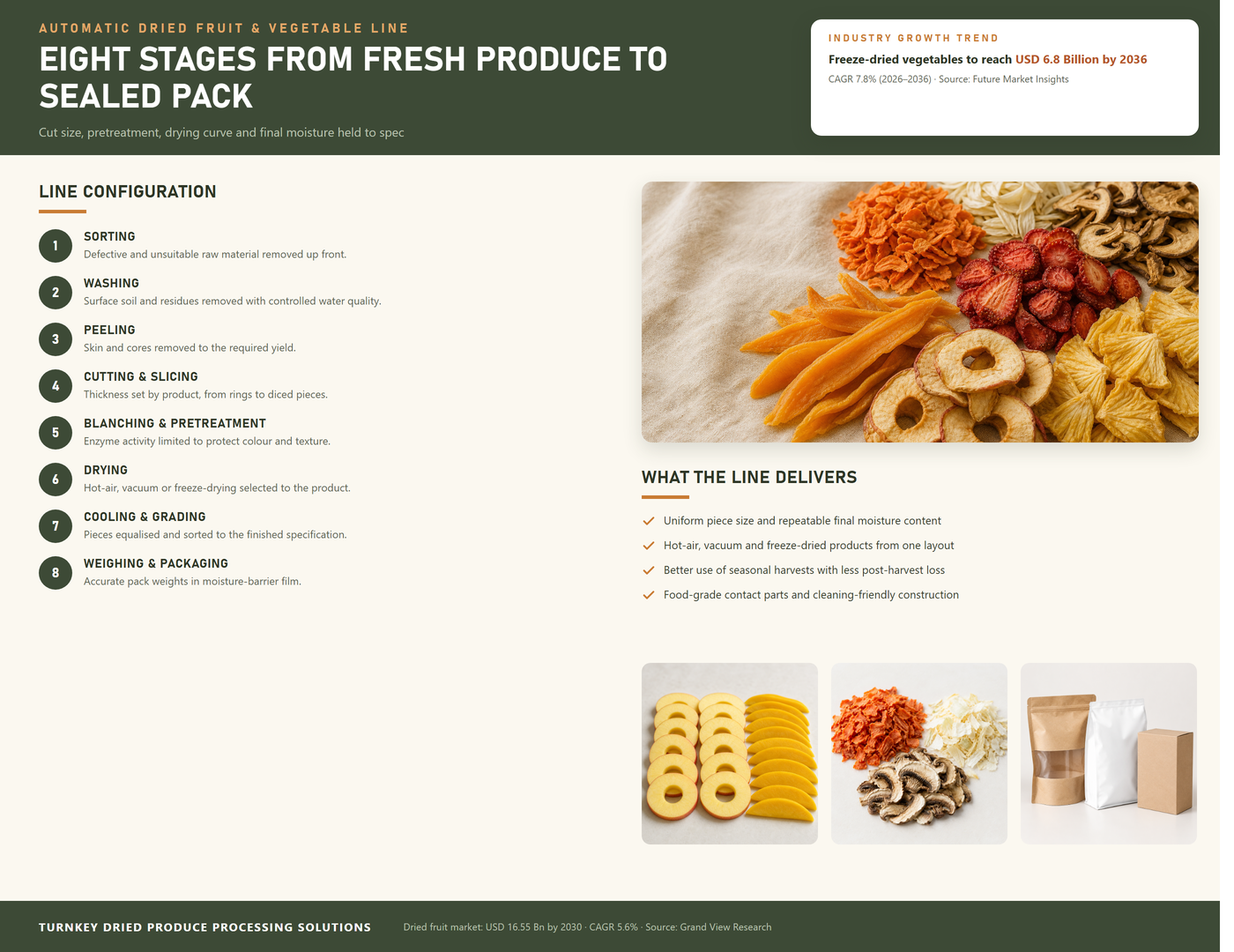
With the growing demand for convenient snacks, fruit-based ingredients, and longer-lasting food products, dried fruits and vegetables are becoming increasingly important in the global food processing industry. Products such as dried mango, banana chips, apple slices, strawberries, pineapple, carrots, onions, mushrooms, tomatoes, and leafy vegetables are widely used in snack manufacturing, breakfast cereals, bakery products, soups, instant meals, seasoning blends, and foodservice applications. Consumers are increasingly interested in convenient foods with recognizable ingredients, while manufacturers are looking for effective ways to extend product usability, reduce post-harvest losses, and create value from seasonal agricultural produce. An automatic dried fruit and vegetable production line provides an integrated solution for transforming fresh raw materials into commercially marketable dried products. Depending on the fruit or vegetable, the line can include sorting, washing, peeling, cutting, slicing, blanching, pretreatment, drying, cooling, grading, weighing, and packaging equipment. Different drying technologies, including hot-air drying, vacuum drying, and freeze-drying, can be selected according to the required texture, color, flavor, nutritional characteristics, production capacity, and investment budget. For example, hot-air drying is widely used for many commercial fruit and vegetable products because of its established technology and practical scalability, while freeze-drying is often selected for premium products where lightweight texture, shape retention, and rehydration performance are important. Modern food-processing development increasingly focuses on improving drying efficiency, protecting product quality, and reducing energy consumption through better pretreatment methods and process control. For manufacturers, the key is not simply to remove moisture, but to choose a suitable processing method that meets the intended product specifications and target market requirements. A well-designed dried fruit and vegetable processing line can help food factories expand their product ranges, improve the utilization of agricultural materials, and supply distributors, supermarkets, snack brands, ingredient manufacturers, and international food markets with more consistent finished products.
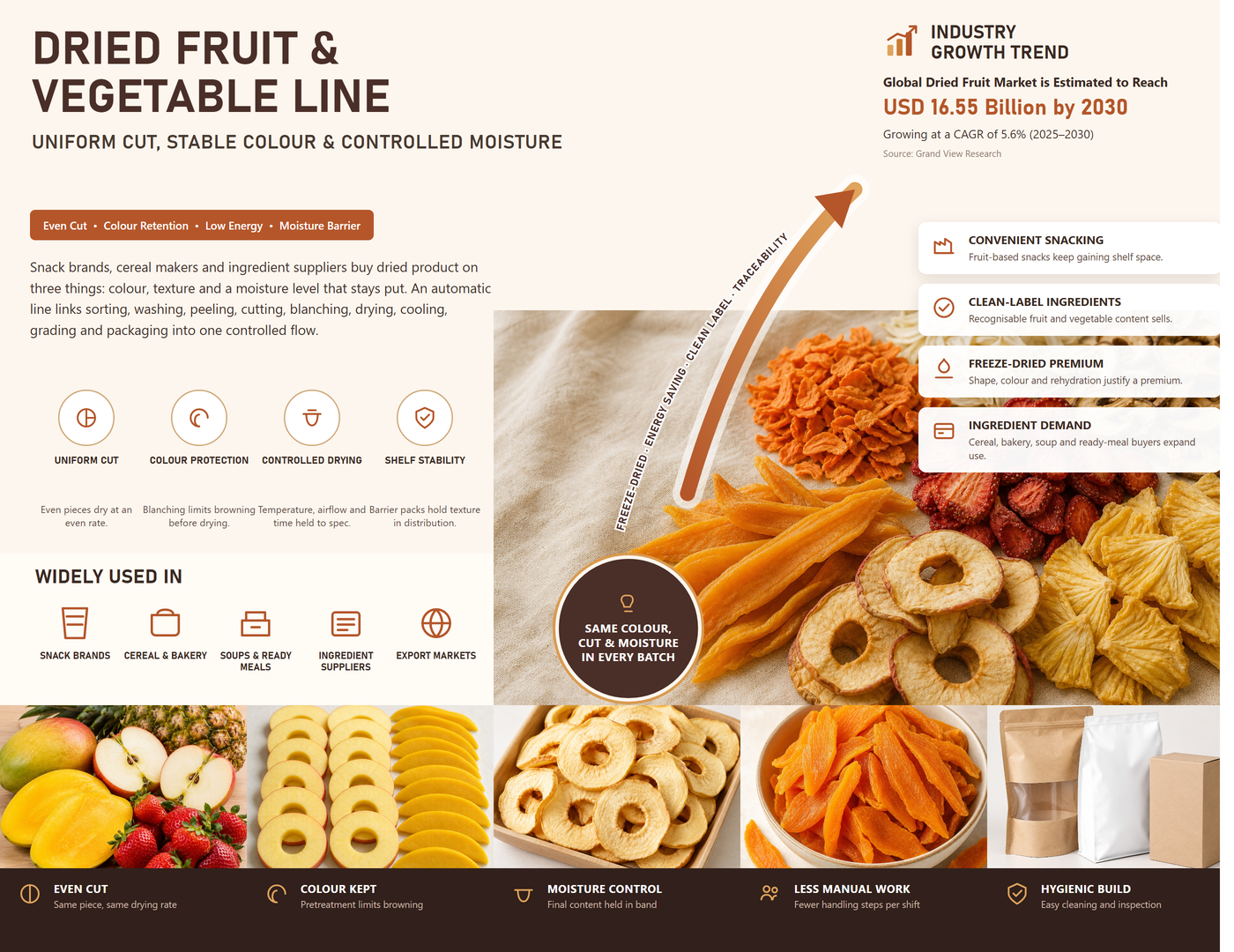
One of the most important advantages of an industrial dried fruit and vegetable production line is its ability to improve production efficiency and product consistency. Manual processing or disconnected machines can create variations in washing quality, slice thickness, pretreatment conditions, drying uniformity, final moisture content, and packaging weight. An integrated production system helps coordinate these stages and establish a more standardized workflow. Automatic washing and sorting equipment can remove surface impurities and separate unsuitable raw materials, while slicing machines help produce more uniform pieces for predictable processing. Depending on the product, blanching or other suitable pretreatment methods may help control enzymatic browning, improve color, or influence drying performance. The drying system is particularly important because temperature, airflow, humidity, loading density, and drying time can significantly affect the final color, flavor, texture, and moisture distribution. Modern systems can use adjustable temperature settings, controlled airflow, and monitoring instruments to help operators manage these variables more effectively. Intelligent food drying technologies increasingly use sensors, predictive models, and automated control to monitor moisture changes and improve process management. These technologies can help reduce unnecessary over-drying and improve batch repeatability when properly configured and validated. After drying, cooling, grading, and suitable packaging help protect the finished products and prepare them for storage or distribution. Food safety must remain a priority throughout the process: equipment should use appropriate food-contact materials, support effective cleaning, and allow practical inspection and maintenance. Manufacturers also need suitable controls for raw material quality, water quality, microbial risks, final moisture content, water activity, and packaging integrity. Dried products are not automatically microbiologically safe simply because their moisture content is low; appropriate processing controls and validated food safety procedures remain essential. Packaging should be selected according to the product's moisture sensitivity, oxygen exposure, storage conditions, and distribution period. Moisture-barrier packaging is especially important for products that must retain a crisp texture. By combining suitable equipment with effective operating procedures, manufacturers can reduce avoidable waste, improve finished-product uniformity, simplify quality management, and establish a more reliable manufacturing process.
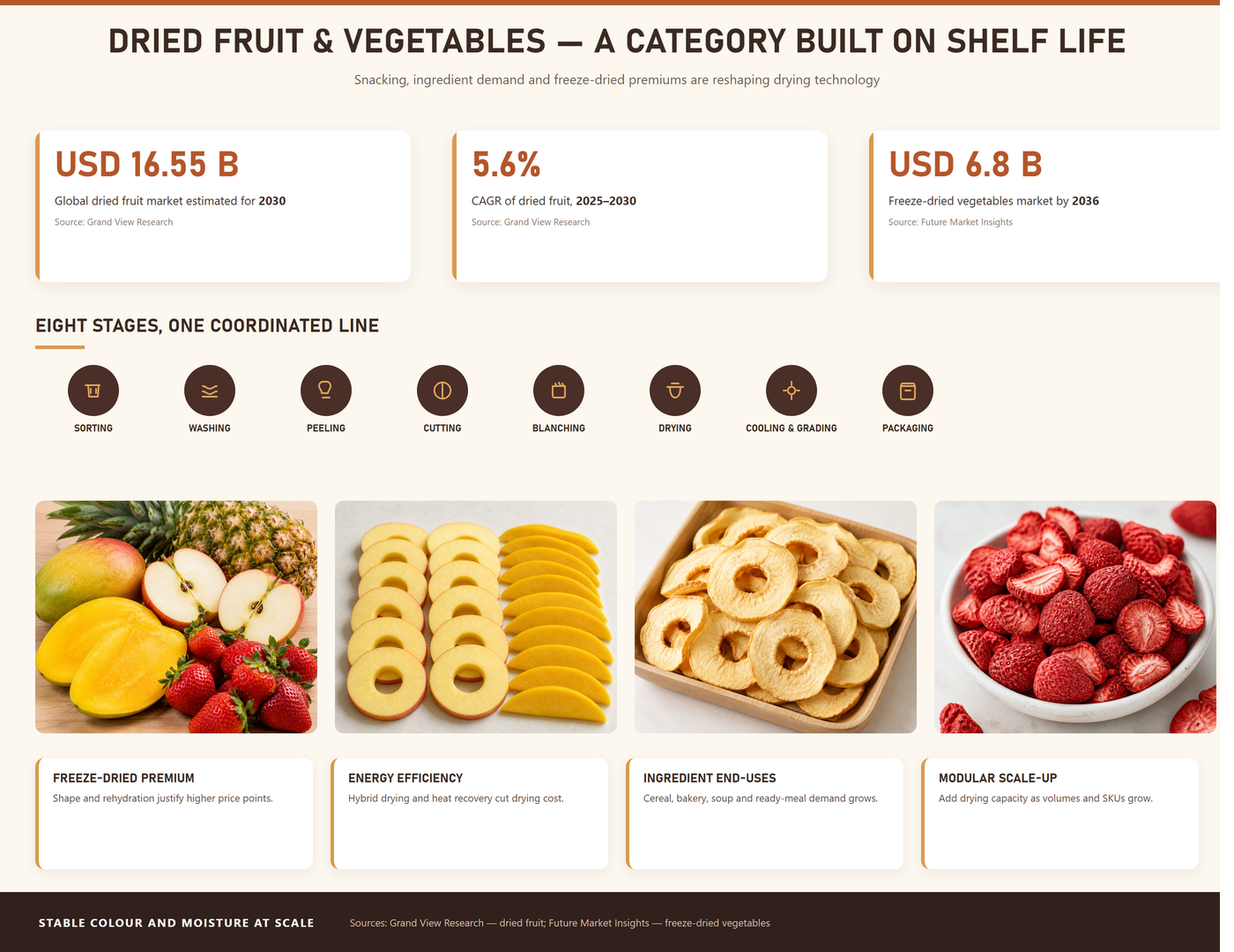
Looking ahead, the dried fruit and vegetable industry is expected to continue exploring smart manufacturing, energy efficiency, product innovation, and more flexible processing solutions. The development of premium freeze-dried snacks, vegetable ingredients for ready meals, fruit pieces for bakery and cereal applications, and convenient cooking ingredients creates opportunities for factories to serve several customer segments using appropriately configured equipment. At the same time, manufacturers are paying greater attention to energy use because drying can be one of the most resource-intensive stages of food processing. New approaches include hybrid drying technologies, pretreatment optimization, heat management, and intelligent monitoring to improve efficiency while maintaining product quality. The actual benefits depend on the raw material, drying method, equipment design, operating conditions, and quality targets, so production trials and energy assessments are valuable when selecting a system. Depending on the factory's requirements, a modern production line may incorporate PLC control, touchscreen operation, temperature and humidity monitoring, automated conveying, and digital recording of key processing parameters. These functions can improve operational visibility and help production teams identify variations between batches. Resource efficiency can also be supported through optimized cutting, suitable loading arrangements, heat recovery where practical, effective equipment maintenance, and well-planned cleaning procedures. For small and medium-sized businesses, a modular dried fruit and vegetable processing line can provide a manageable starting point, with additional drying capacity, grading, and packaging equipment introduced as demand increases. Large-scale manufacturers may prefer a complete automated line that integrates raw material preparation, drying, finished-product handling, and packaging. When choosing a dried fruit and vegetable production line manufacturer, buyers should evaluate the types of raw materials supported, required hourly capacity, pretreatment options, drying technology, finished-product specifications, energy consumption, cleaning requirements, installation conditions, spare parts availability, and after-sales technical support. It is also important to clarify whether the stated capacity refers to fresh raw materials or finished dried products, because moisture removal can significantly change product weight and throughput. By selecting a processing solution based on real production requirements, food manufacturers can improve efficiency, create differentiated dried products, make better use of agricultural resources, and strengthen their competitiveness in the global food processing market.
Mobile: +86 15094949111
WhatsApp: +86 15094949111
Skype: +86 15094949111
WeChat: +86 15094949111
Email: caroline@zekomachinery.com