
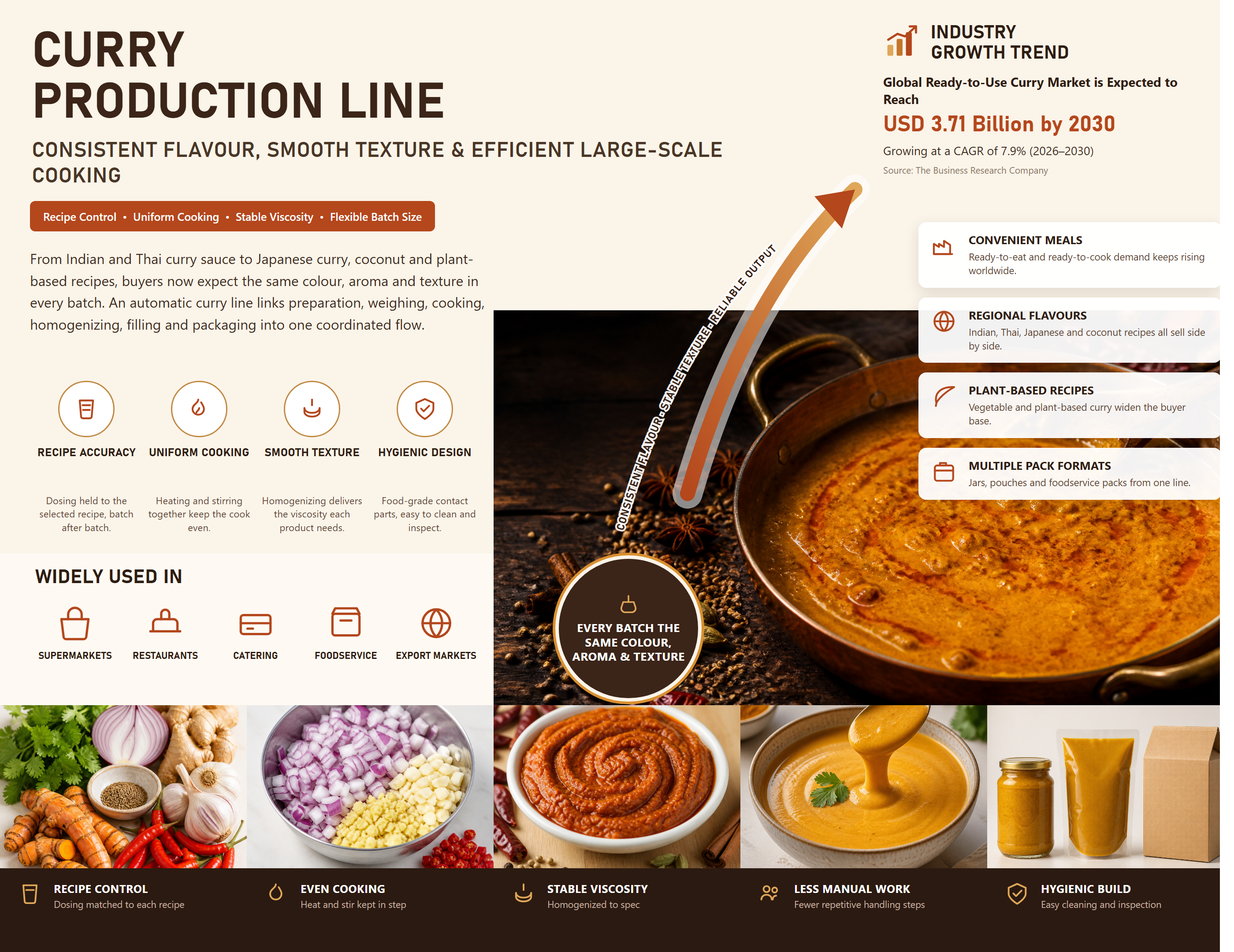
Curry production line
Automatic Curry Production Line: Efficient Curry Sauce Processing Solutions
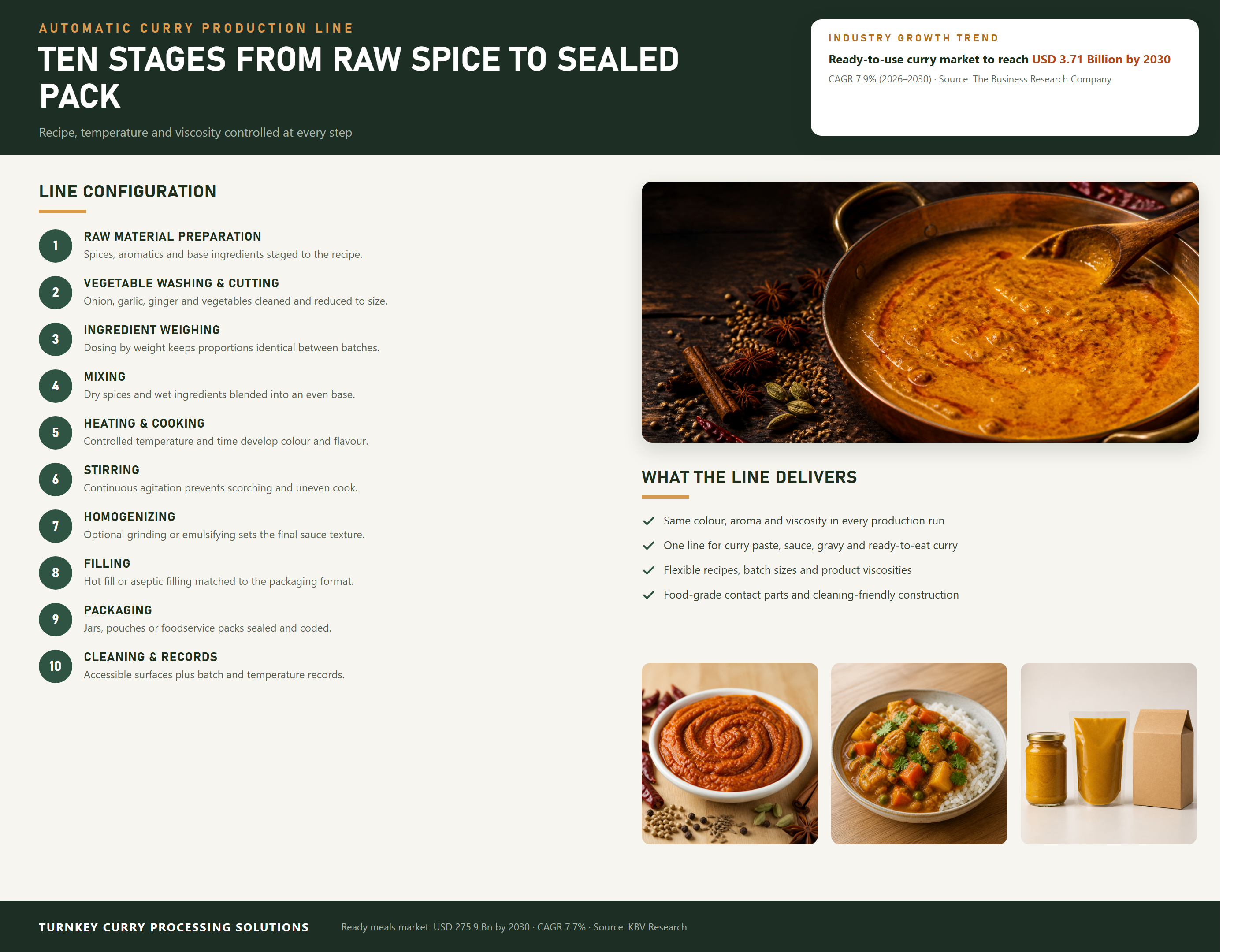
With the growing demand for convenient meals, international cuisines, ready-to-eat foods, and ready-to-cook meal solutions, curry products are gaining opportunities across supermarkets, restaurants, catering businesses, foodservice suppliers, and food manufacturing companies. From traditional Indian curry and Thai curry sauce to Japanese curry, coconut curry, vegetable curry, and plant-based curry products, manufacturers need reliable processing solutions that deliver consistent flavor, smooth texture, stable quality, and efficient large-scale production. A modern automatic curry production line helps food manufacturers streamline essential processing stages, including raw material preparation, vegetable washing and cutting, ingredient weighing, mixing, heating, cooking, stirring, sauce homogenization, filling, and packaging. Depending on the recipe and final product, the line can be configured for curry paste, curry sauce, curry gravy, ready-to-eat curry meals, and other customized seasoning products. As consumers increasingly seek convenient meal preparation without compromising taste, manufacturers must also respond to changing preferences for authentic regional flavors, customizable spice levels, plant-based ingredients, and different packaging formats. These market opportunities make automatic curry processing equipment an important investment for businesses seeking to expand product ranges, improve production capacity, and serve both domestic and international markets. A professionally designed curry processing system allows manufacturers to coordinate multiple processing stages, reduce unnecessary manual handling, and establish a more consistent production workflow.
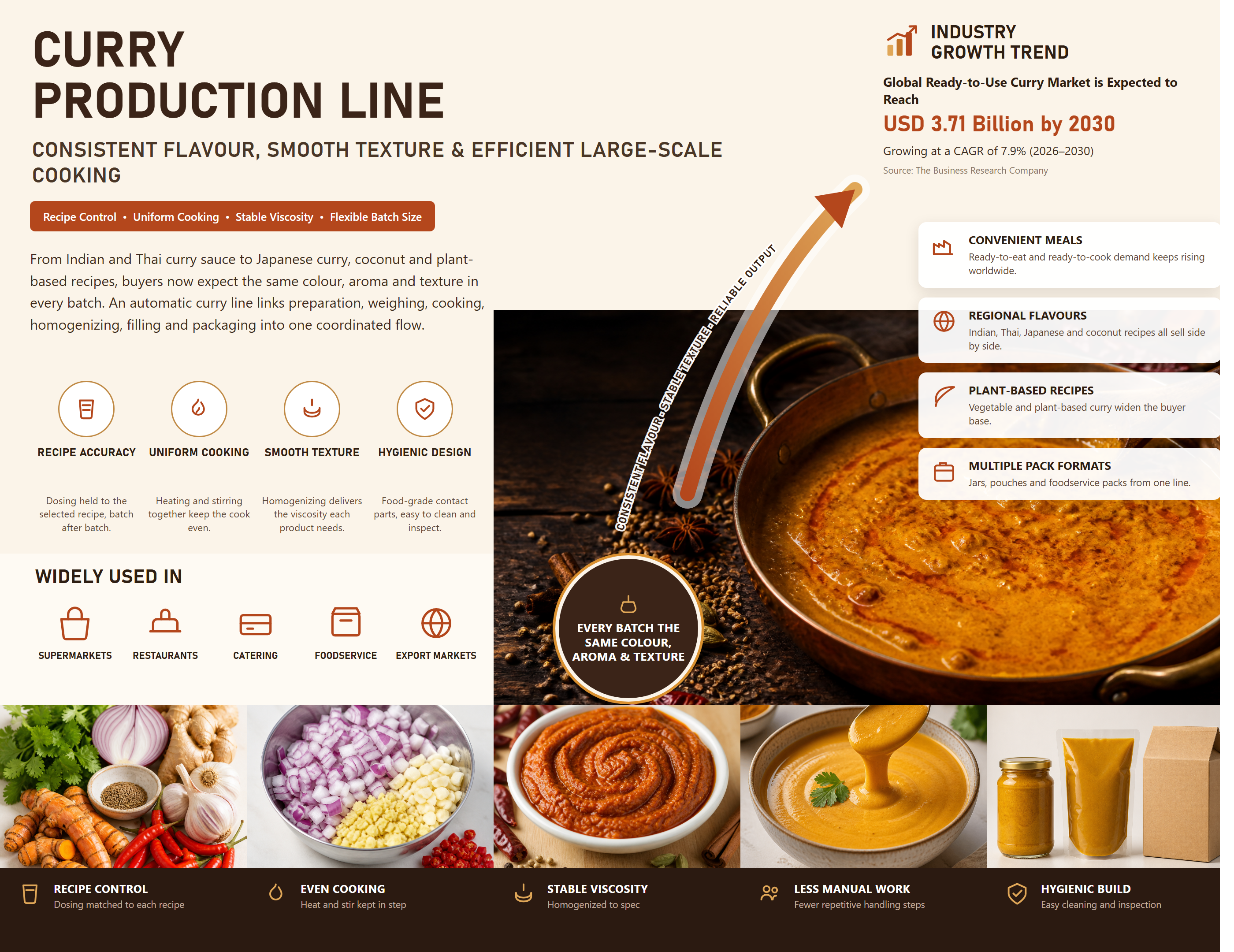
One of the major advantages of an industrial curry production line is its ability to improve processing efficiency while maintaining product consistency. In manual production, ingredient proportions, heating conditions, stirring intensity, and processing time may vary between batches, potentially affecting color, flavor, viscosity, and final product quality. An appropriately configured automated system can help control ingredient dosing, mixing, temperature, and cooking time according to the selected recipe and equipment specifications. Heating and stirring systems support uniform cooking, while optional grinding, emulsifying, or homogenizing equipment can help achieve the required sauce texture. For factories producing multiple curry varieties, a flexible production line can be designed to accommodate different recipes, batch sizes, and product viscosities. Automation can also reduce repetitive labor, improve equipment utilization, and make production planning easier, although actual output and labor savings depend on the recipe, line configuration, and operating conditions. Food safety and hygienic design are equally important considerations. Food-contact components should use suitable food-grade materials, and equipment should be designed to support effective cleaning, residue removal, and routine maintenance. Manufacturers should also establish appropriate controls for raw material handling, cooking temperatures, filling conditions, allergen management, and batch records. Where required, validated thermal processing, suitable filling technology, and compatible packaging can help achieve the intended shelf life and storage conditions. Importantly, shelf stability cannot be guaranteed by the processing line alone; it depends on the formulation, validated processing method, packaging system, and storage requirements. These capabilities help curry manufacturers improve repeatability, strengthen quality management, and build greater confidence among distributors, retailers, and foodservice customers.
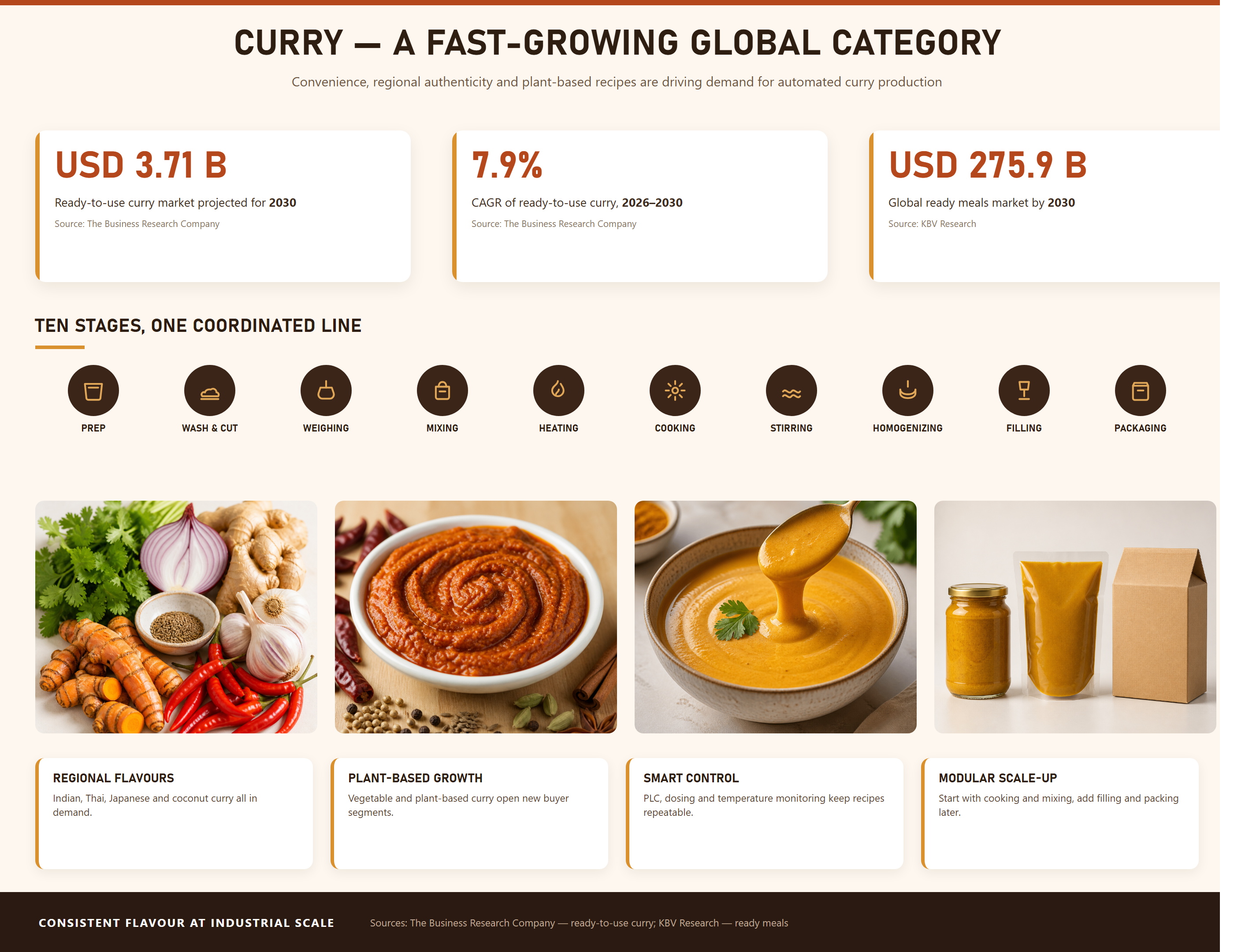
Looking ahead, the curry processing industry is increasingly influenced by smart manufacturing, flexible production, traceability, and resource efficiency. Food manufacturers are looking beyond individual machines and evaluating integrated curry sauce production lines that connect preparation, cooking, conveying, filling, and packaging into a coordinated process. Depending on project requirements, PLC controls, touchscreen operation, automatic ingredient dosing, temperature monitoring, and production data recording can help operators manage recipes and monitor critical processing parameters. Digital monitoring and optional inspection systems may also support quality control and faster identification of production issues. Sustainability is another important consideration: accurate ingredient dosing, efficient heating, optimized production scheduling, and well-designed cleaning procedures can help reduce avoidable material, energy, and water waste. For small and medium-sized manufacturers, a modular curry processing line provides the flexibility to begin with essential cooking and mixing equipment before expanding filling, packaging, or automation capacity as demand grows. For large-scale factories, a customized turnkey solution can integrate higher-capacity processing equipment and downstream packaging systems to meet specific production targets. ZEKO Machinery can position its curry production line solutions around each customer's recipe, raw materials, required capacity, factory layout, packaging format, and target market, helping buyers evaluate a suitable configuration rather than purchasing equipment based on capacity alone. When selecting a curry production line manufacturer, buyers should assess processing compatibility, temperature control, hygienic construction, cleaning accessibility, energy consumption, spare parts availability, installation support, and after-sales technical service. By combining appropriate equipment selection with reliable process design, an automatic curry production line can help food manufacturers improve operational efficiency, maintain consistent product quality, develop new curry products, and strengthen their competitiveness in the global prepared-food market.
Mob: +86 15094949111
WhatsApp: +86 15094949111
Skype: +86 15094949111
WeChat: +86 15094949111
Email: caroline@zekomachinery.com