Coffee production line
Automatic Coffee Production Line: Advantages and Future Market Trends
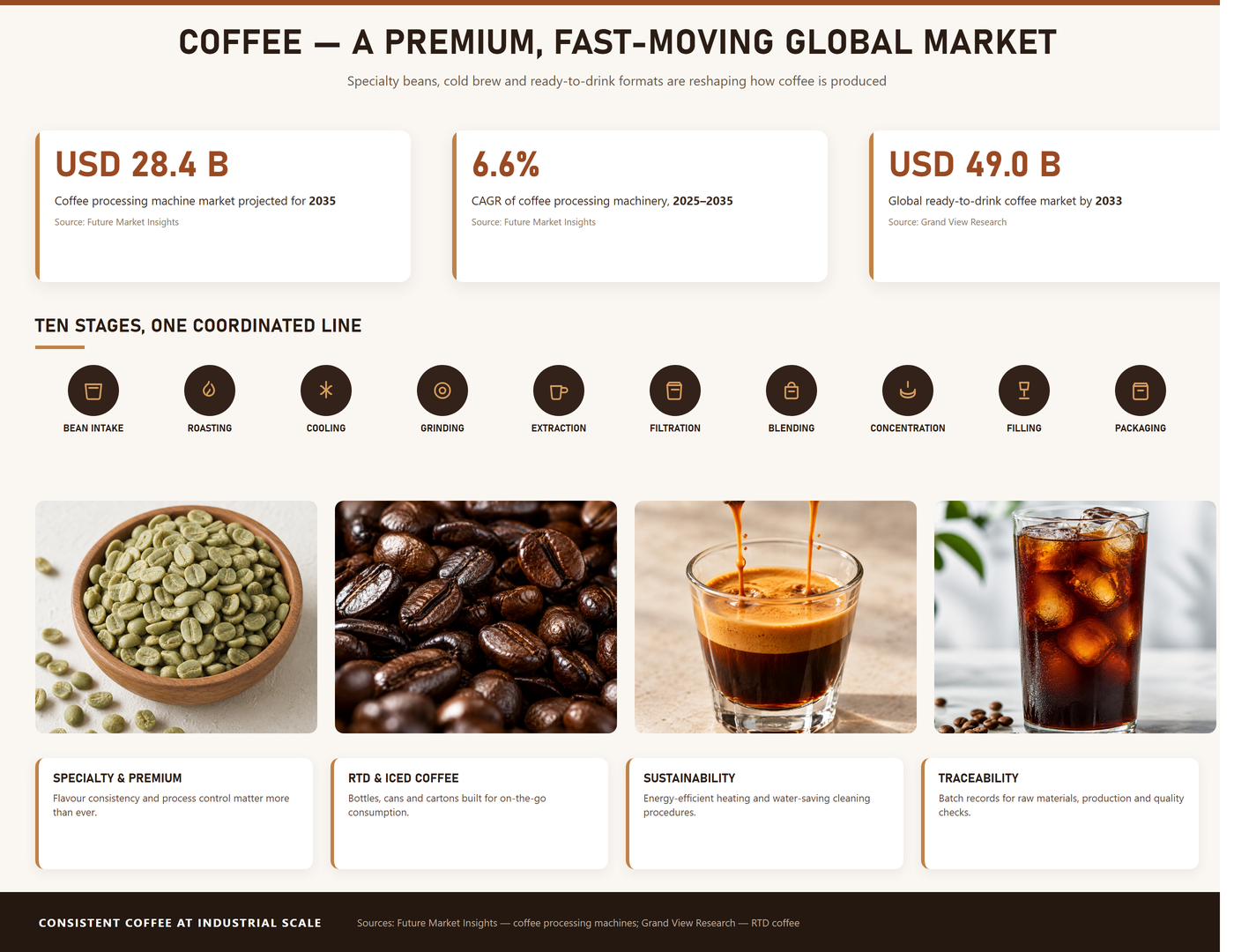
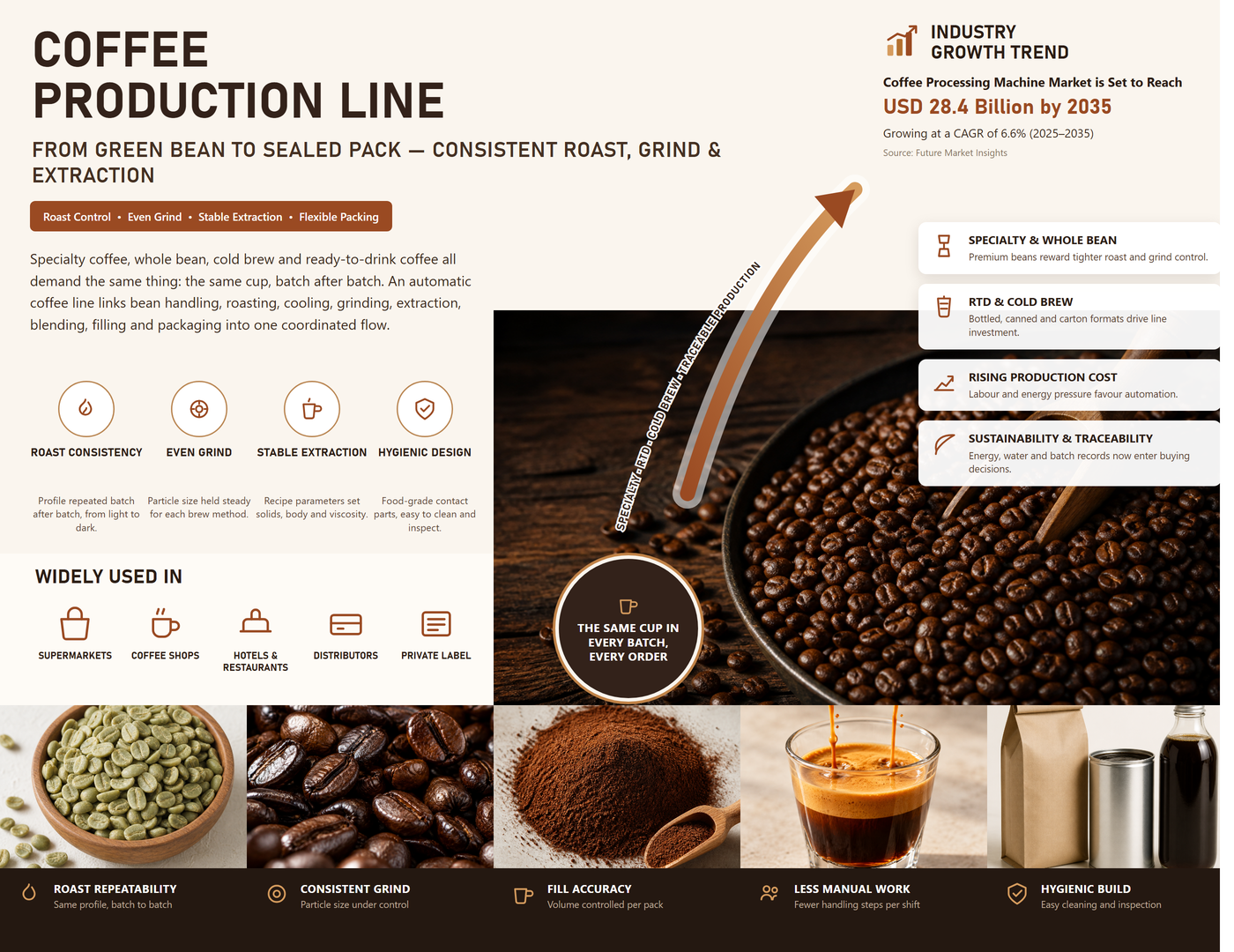
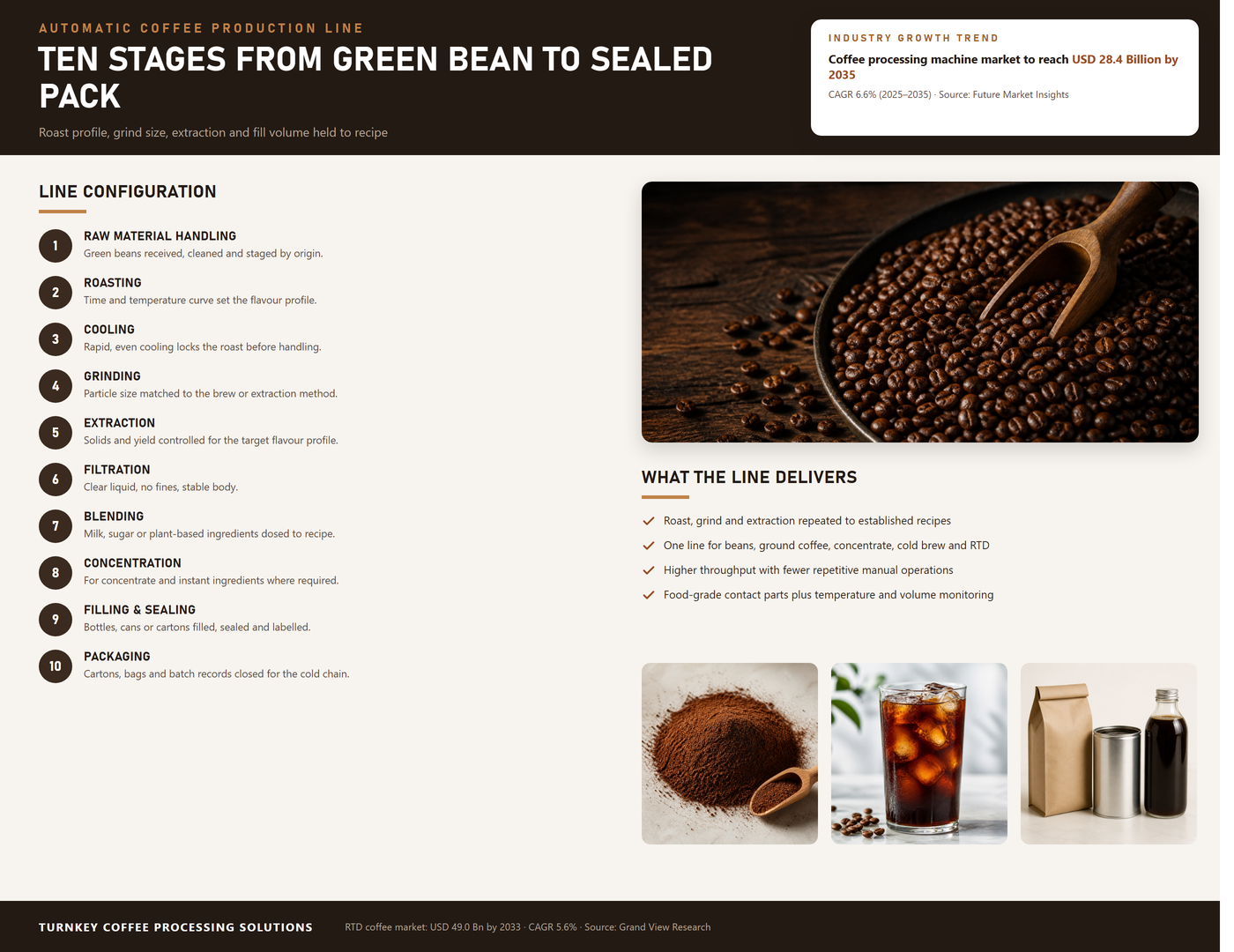
With the continuous development of the global coffee industry, coffee manufacturers are facing new opportunities and challenges driven by changing consumer preferences, rising production costs, product innovation, and increasing expectations for quality and sustainability. In 2026, specialty coffee, premium whole-bean coffee, cold brew, ready-to-drink (RTD) coffee, and convenient coffee beverages remain important areas of industry development. These trends create opportunities for manufacturers to expand their product portfolios and improve production capabilities. An automatic coffee production line provides an integrated solution for coffee processing businesses that want to improve efficiency, maintain product consistency, and respond quickly to market demand. Depending on the product type, a coffee processing line may include raw material handling, bean roasting, cooling, grinding, extraction, filtration, blending, concentration, filling, sealing, labeling, and packaging equipment. Different configurations can support roasted coffee beans, ground coffee, instant coffee ingredients, coffee concentrate, cold brew, and ready-to-drink coffee beverages. For beverage manufacturers, an automatic coffee beverage production line can integrate water treatment, ingredient mixing, extraction or preparation, thermal processing where required, and downstream filling and packaging. By coordinating these stages, manufacturers can reduce unnecessary manual handling, simplify production management, and establish a more standardized workflow. As international buyers increasingly look for reliable coffee processing equipment and customized turnkey solutions, selecting the right production line is becoming an important step toward improving competitiveness in the global coffee market.
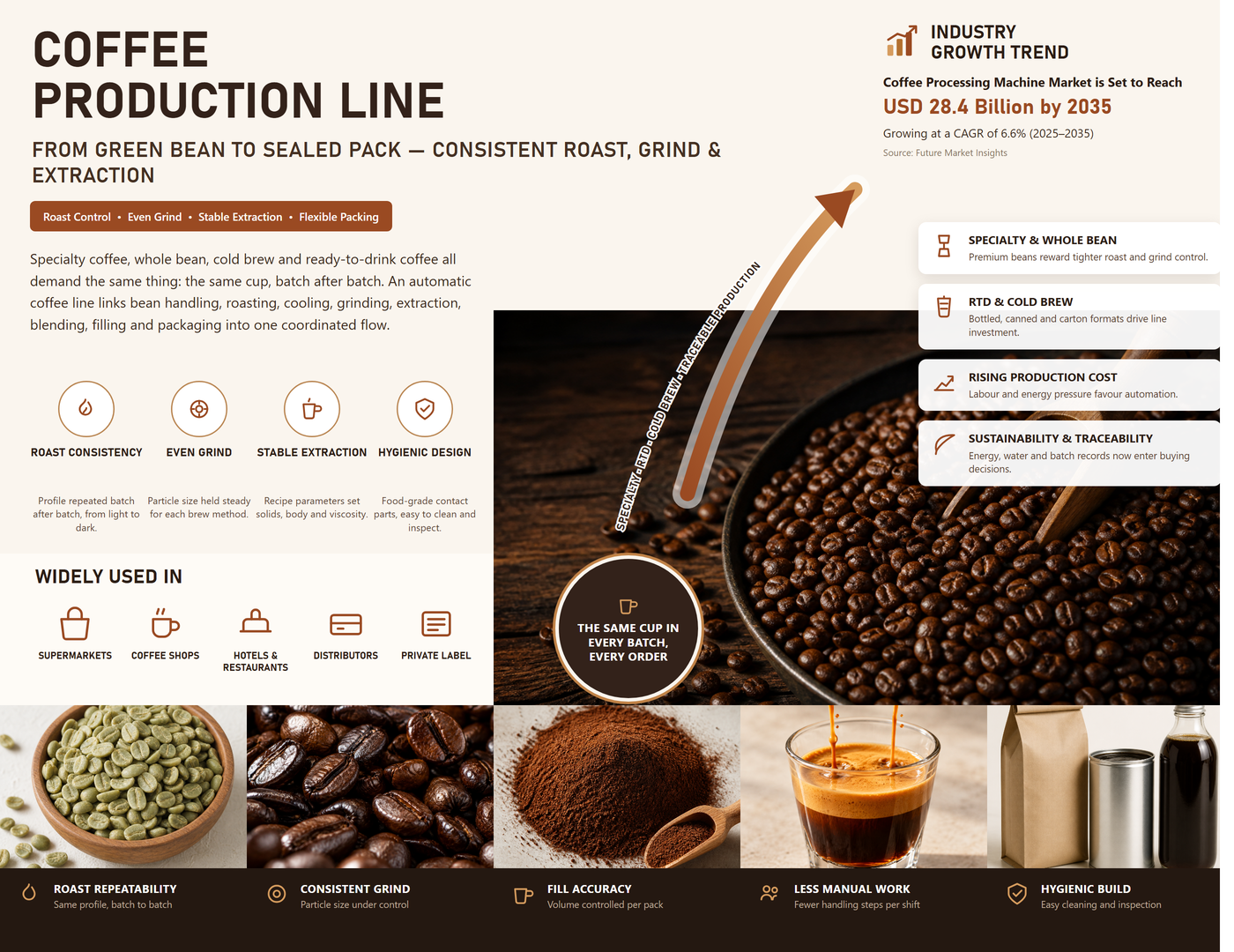
One of the most significant advantages of an industrial coffee production line is its ability to improve production efficiency and product consistency. Manual or disconnected processing operations can lead to variations in roasting profiles, grinding size, ingredient ratios, extraction conditions, filling volumes, and packaging quality. An appropriately configured automated system can help operators control important parameters and repeat established recipes more consistently. For roasted coffee production, suitable roasting, cooling, conveying, and grinding equipment can support a more organized process from green beans to finished products. For liquid coffee manufacturing, extraction, filtration, mixing, and filling systems can be selected according to the required flavor profile, solids content, viscosity, and packaging format. Automation can also help manufacturers increase throughput, reduce repetitive labor, improve production scheduling, and make better use of factory space. These benefits are particularly valuable for businesses supplying supermarkets, coffee shops, restaurants, hotels, catering companies, distributors, and private-label brands. Food safety and quality management are equally important. Food-contact components should be made from suitable food-grade materials, while hygienic equipment design and effective cleaning procedures help reduce contamination risks. For ready-to-drink coffee, the appropriate thermal processing, filling, sealing, and storage arrangements must be determined according to the formulation, packaging material, and intended shelf life. Products containing milk or plant-based ingredients may require additional controls for ingredient handling, allergen management, and processing conditions. Modern production lines can also incorporate temperature monitoring, automatic dosing, filling-volume control, inspection equipment, and batch-recording functions. These features support more consistent production and improve operational oversight. Actual performance depends on the equipment configuration, product formulation, factory conditions, and validated operating procedures.
Looking toward the future, the coffee manufacturing industry is increasingly focused on flexible production, digital monitoring, sustainable operations, and the development of new beverage formats. The continued popularity of iced coffee and ready-to-drink products creates opportunities for manufacturers to develop bottled, canned, and carton-packed beverages for retail and on-the-go consumption. At the same time, demand for specialty coffee and premium products encourages greater attention to flavor consistency, ingredient quality, and process control. An advanced coffee processing line can be designed with modular equipment, PLC control, touchscreen operation, and optional production data monitoring to support more flexible manufacturing. Depending on the project, manufacturers may also consider energy-efficient heating systems, optimized extraction processes, water-saving cleaning procedures, and packaging options suited to their sustainability goals. Traceability is another growing consideration for international supply chains, where buyers may need better records of raw materials, production batches, and quality checks. For small and medium-sized enterprises, a modular coffee production line can provide a practical starting point, allowing production capacity and automation to expand as demand grows. Large factories may benefit from integrated solutions connecting processing, filling, packaging, and inspection equipment into a coordinated manufacturing system. When evaluating a coffee production line manufacturer, buyers should consider processing compatibility, automation level, hygiene design, energy and water consumption, maintenance requirements, spare parts availability, installation guidance, and after-sales technical support. By choosing a suitable configuration and optimizing the complete production workflow, coffee manufacturers can improve operational efficiency, maintain reliable product quality, introduce new coffee products, and strengthen their position in the increasingly competitive global beverage industry.