
Bread production line
Automatic Bread Production Line: Advantages and Future Trends in Bakery Manufacturing
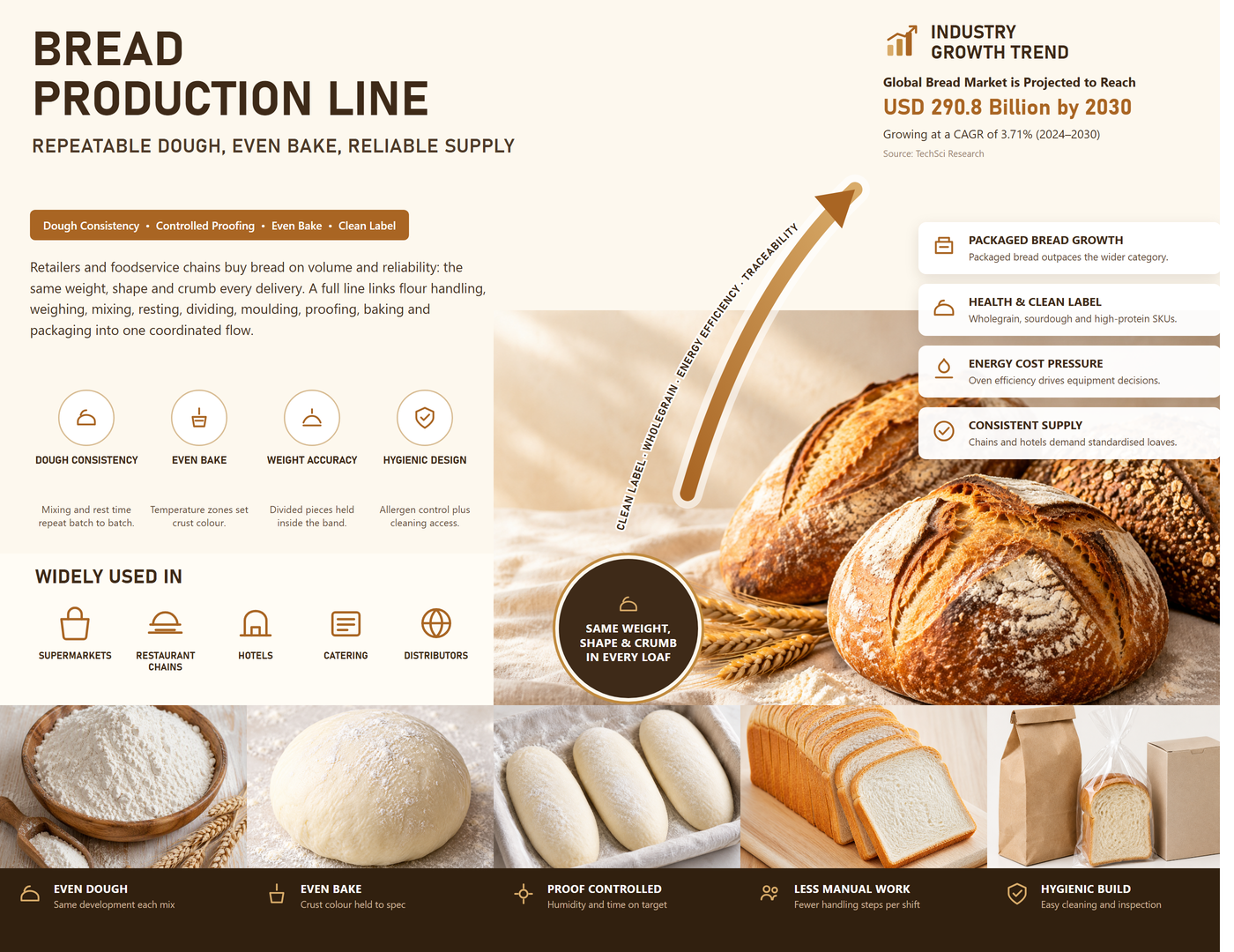
With the continuous development of the global bakery industry, bread manufacturers are facing increasing demand for consistent quality, convenient food products, flexible production, and efficient manufacturing processes. Bread remains an essential food product in many markets, while consumer preferences are expanding toward whole-grain bread, sourdough, high-protein bread, seeded bread, sandwich bread, hamburger buns, toast, and other specialty bakery products. In 2026, clean-label formulations, health-oriented bakery products, product innovation, and sustainable manufacturing are important industry trends. Manufacturers must therefore balance traditional bread quality with modern production efficiency and the ability to respond quickly to changing market demand. An automatic bread production line provides an integrated solution for bakeries seeking to standardize production, improve output, and reduce unnecessary manual handling. Depending on the product and required capacity, a complete bread processing line may include flour handling, ingredient weighing, dough mixing, dough resting, dividing, rounding, molding, proofing, baking, cooling, slicing, and packaging equipment. For specialized applications, additional systems can be configured for toast bread, baguettes, burger buns, sandwich bread, whole-wheat bread, and other baked products. A well-designed bread manufacturing line connects these stages into a coordinated workflow, helping factories manage production more efficiently while maintaining consistent product specifications. As supermarkets, restaurant chains, hotels, catering companies, and food distributors seek reliable supplies of standardized bakery products, investing in suitable industrial bread production equipment can help manufacturers expand production capacity, improve delivery reliability, and develop new product categories. Rather than relying on a collection of disconnected machines, a properly configured production line allows each stage to be matched to the dough characteristics, recipe, product size, and desired output, providing a stronger foundation for long-term business growth.
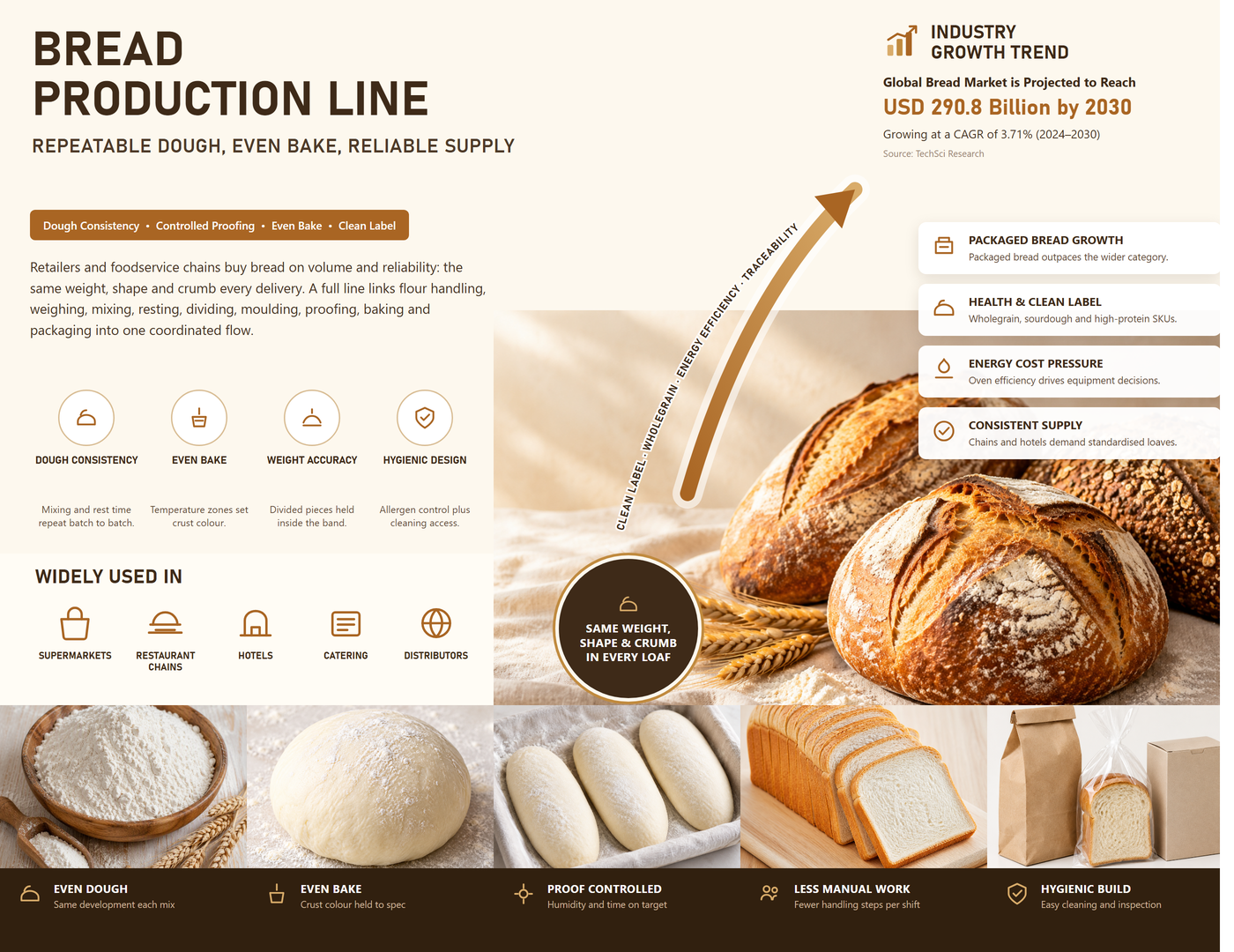
One of the most important advantages of an industrial bread production line is improved efficiency and product consistency. Manual processing can create variations in ingredient proportions, dough development, portion weight, loaf shape, proofing conditions, baking color, and finished-product texture. Automated dough mixing, dividing, rounding, molding, and conveying systems help standardize repetitive operations and support more consistent results when recipes and process parameters are properly controlled. Accurate ingredient dosing helps maintain formulation consistency, while controlled proofing conditions support suitable dough fermentation and product structure. Modern tunnel ovens, rotary ovens, or other suitable baking systems can be selected according to product type, production capacity, factory layout, and energy requirements. After baking, cooling conveyors, bread slicers, and automatic packaging machines can help organize downstream handling and prepare products for distribution. These integrated processes can reduce bottlenecks, improve equipment utilization, and lower the amount of repetitive manual work required. Automation may also help reduce product waste by improving portion control and process repeatability, although actual savings depend on raw material quality, equipment configuration, recipe design, and operator practices. Food safety and hygiene are equally important for commercial bakeries. Equipment should use suitable food-contact materials and provide accessible surfaces for cleaning, inspection, and maintenance. Proper ingredient storage, allergen management, pest control, cleaning procedures, and production records remain essential parts of a comprehensive food safety system. For packaged bread, cooling before slicing and packaging is important because excessive residual heat and moisture can affect package conditions and product quality. Manufacturers must also consider packaging suitability, storage temperature, humidity, formulation, and applicable food safety requirements when determining shelf life. As demand grows for healthier and more distinctive bakery products, flexible bread production equipment becomes increasingly valuable. A suitable line can be configured to handle different dough recipes, grain inclusions, product dimensions, and loaf formats, helping manufacturers respond to new market opportunities without replacing the entire production system. However, high levels of automation should be selected according to actual production needs, available technical skills, maintenance capacity, and investment budgets.
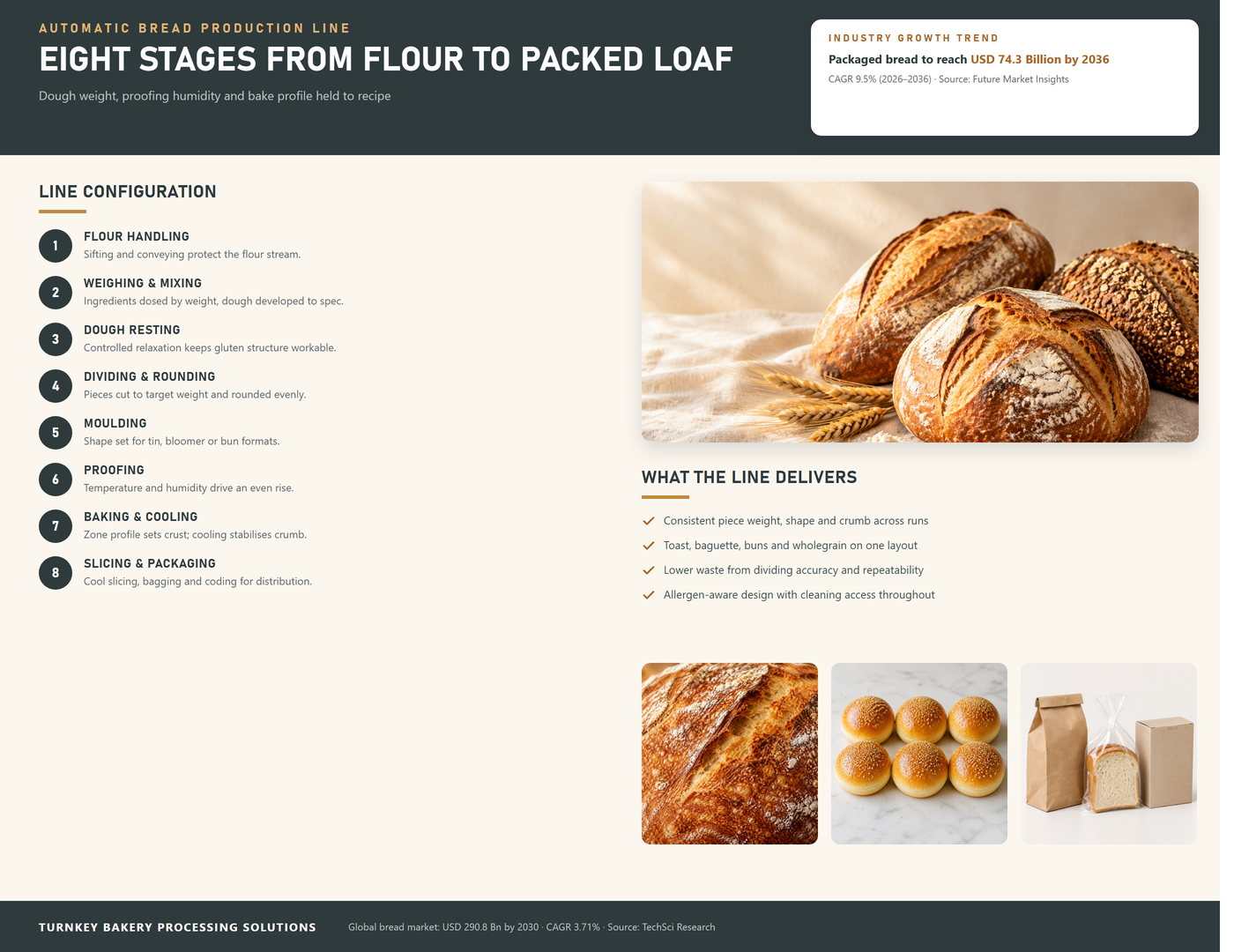
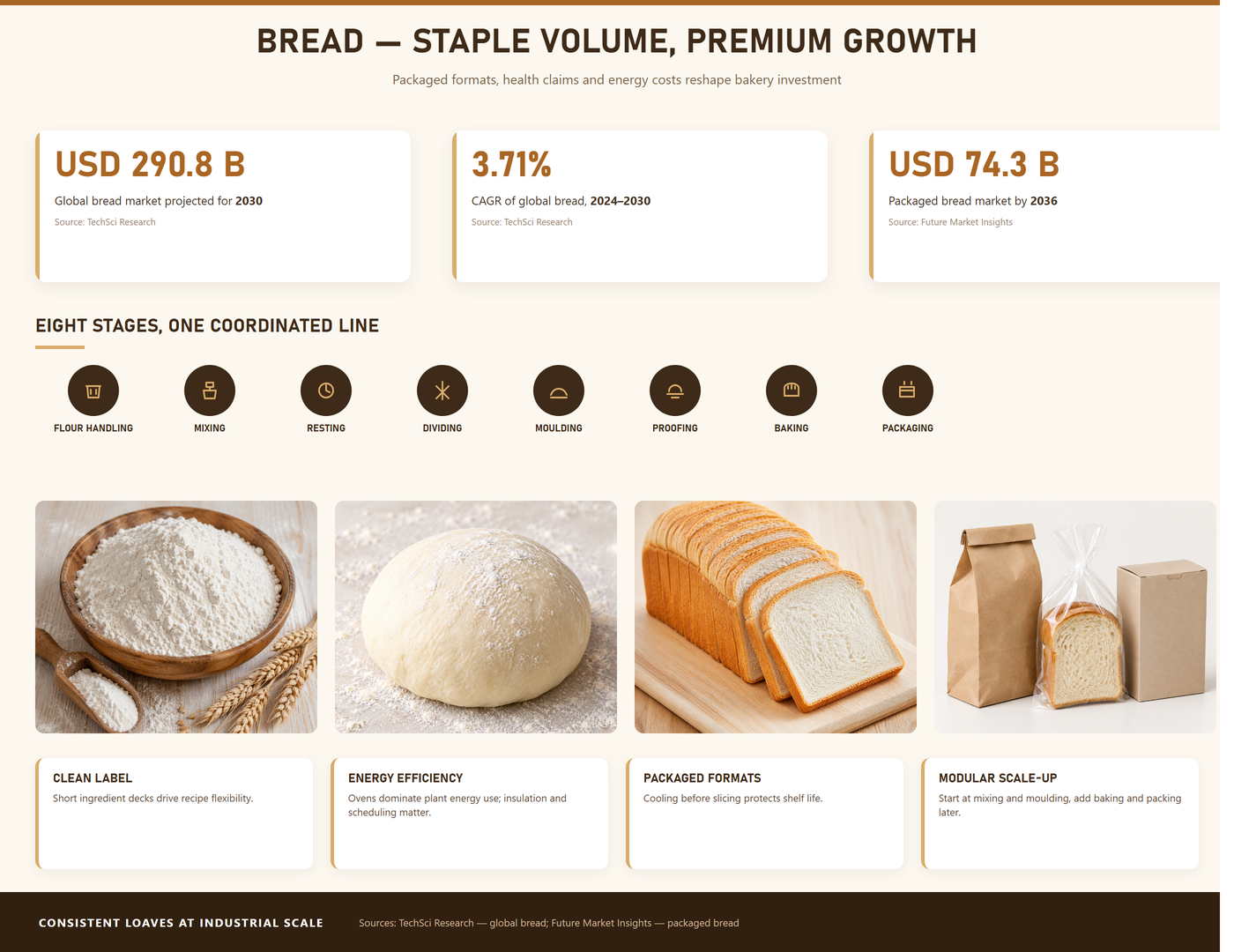
Looking ahead, the bread manufacturing industry is increasingly focused on smart production, energy efficiency, product flexibility, and improved resource utilization. Industry developments in 2026 highlight the growing importance of digital process monitoring, flexible equipment design, clean-label product development, and energy-conscious baking operations. These changes are encouraging manufacturers to evaluate not only production speed but also operating costs, recipe adaptability, equipment reliability, and environmental performance. An advanced automatic bread production line can incorporate PLC control, touchscreen operation, temperature and humidity monitoring, programmable recipes, and optional production data recording. These functions can help operators monitor critical parameters, reproduce established settings, and identify process deviations more quickly. For manufacturers developing high-protein bread, whole-grain bread, sourdough, or plant-based bakery products, equipment flexibility is especially important because different dough compositions may require adjustments to mixing, resting, dividing, molding, and proofing conditions. Energy efficiency is another major consideration because baking ovens can account for a significant portion of a bakery's energy consumption. Appropriate oven selection, insulation, production scheduling, preventive maintenance, and heat recovery where practical can help improve energy utilization. Better dough handling, accurate dividing, and efficient packaging can also reduce avoidable material waste. For small and medium-sized bakeries, a modular bread processing line can provide a practical route to automation, allowing businesses to expand from mixing and molding into proofing, baking, slicing, and packaging as demand increases. Large industrial bakeries may benefit from fully integrated systems designed for continuous production and high-volume distribution. When choosing a bread production line manufacturer, buyers should assess production capacity, product range, dough compatibility, automation level, oven performance, energy consumption, cleaning requirements, spare parts availability, installation support, and after-sales technical service. It is also important to confirm expected output using the intended recipe, product weight, and operating conditions. By selecting a suitable configuration and optimizing the entire production process, manufacturers can improve operational efficiency, maintain reliable bread quality, respond to evolving consumer preferences, and strengthen their competitiveness in the global bakery market.
Mobile: +86 15094949111
WhatsApp: +86 15094949111
Skype: +86 15094949111
WeChat: +86 15094949111
Email: caroline@zekomachinery.com