
Beef production line
Automatic Steak Production Line: Advantages, Automation and Future Trends
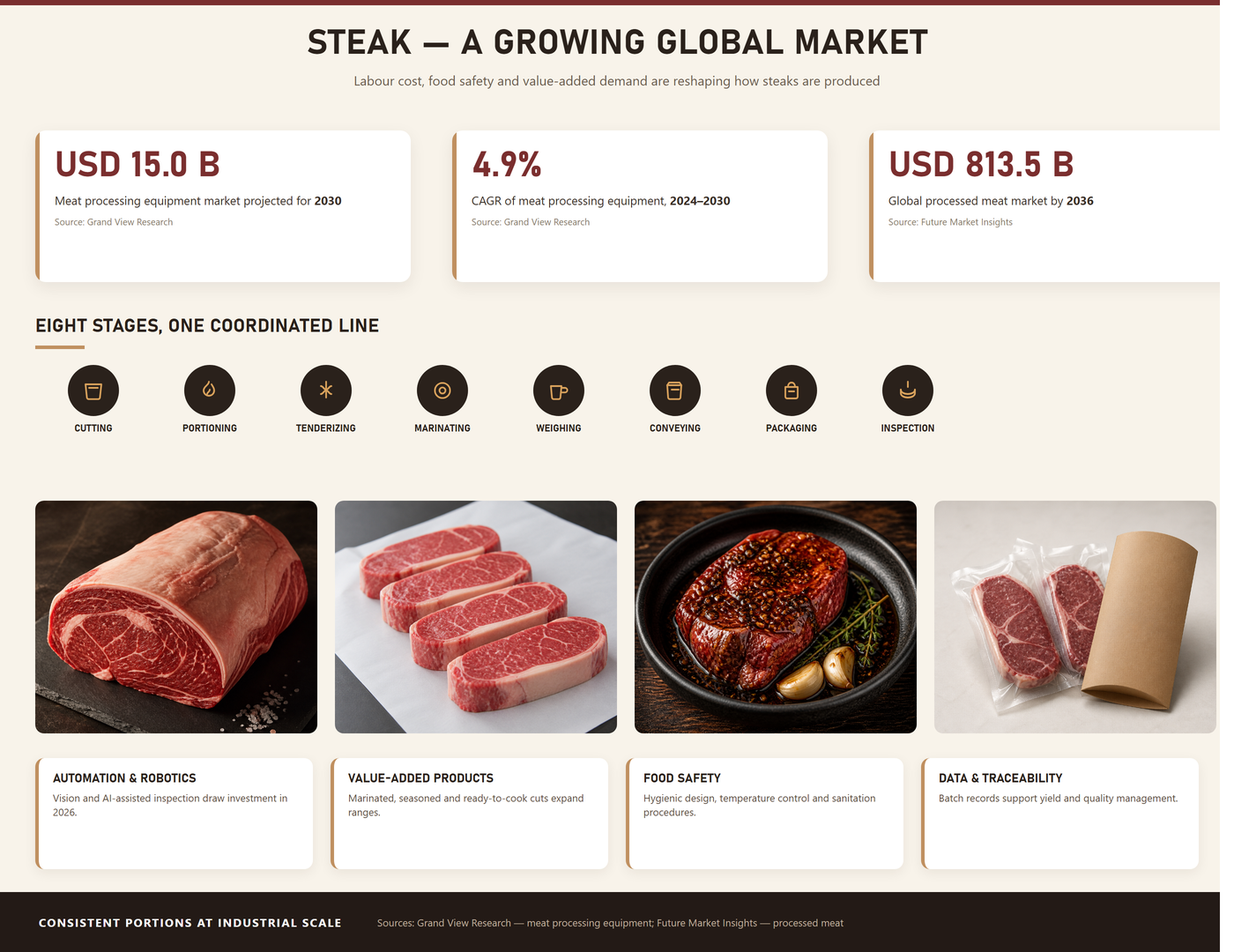
With the increasing demand for premium meat products, convenient meal solutions, and standardized foodservice ingredients, the global steak processing industry is placing greater emphasis on production efficiency, product consistency, food safety, and cost control. Steak products are widely used in restaurants, hotels, supermarkets, butcher shops, catering businesses, and ready-to-cook food manufacturing. From fresh beef steaks and tenderized steaks to marinated beef, pork steaks, chicken steaks, and portion-controlled meat products, manufacturers need reliable processing solutions that can meet different customer requirements while maintaining consistent product quality. An automatic steak production line provides an integrated approach to modern meat processing by coordinating essential operations such as meat cutting, portioning, tenderizing, marinating, weighing, conveying, and packaging. Depending on the product and production capacity, the system can incorporate industrial meat slicers, steak portioning machines, meat tenderizers, vacuum tumblers, weighing systems, and vacuum packaging equipment. As labor costs rise and food manufacturers face growing pressure to improve output without compromising quality, automation is becoming an important investment consideration. Industry analysis for 2026 identifies automation, food safety requirements, and demand for value-added and packaged meat products as important factors influencing the meat processing equipment market. For steak manufacturers, this means moving beyond isolated machines toward a coordinated steak processing line designed around raw material characteristics, target portion sizes, production volume, and final packaging requirements. A properly planned system can help businesses serve both high-volume industrial customers and specialized markets requiring customized cuts, different thicknesses, or specific marinating processes. It can also support product diversification, allowing manufacturers to develop new steak products for retail, foodservice, and ready-to-cook applications while making more efficient use of existing factory resources.
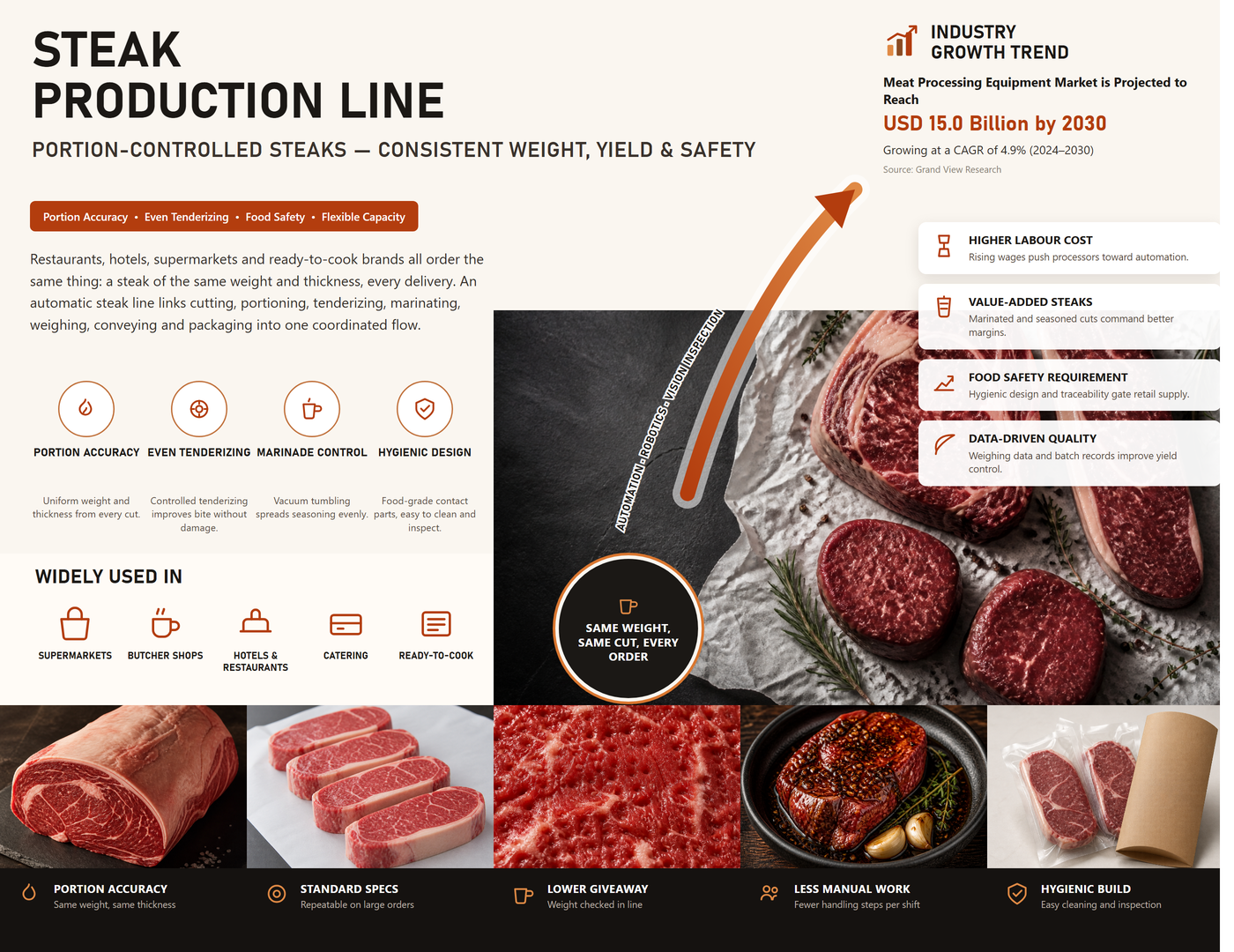
One of the main advantages of an industrial steak production line is its ability to improve portion consistency and streamline repetitive processing operations. In manual production, differences in operator technique, cutting thickness, portion weight, and tenderizing methods can lead to uneven product appearance, variable yields, and difficulties in standardizing finished products. Automated cutting and portioning equipment can help manufacturers achieve more consistent specifications when raw materials and machine settings are suitable for the application. For businesses supplying restaurants, hotels, supermarkets, and central kitchens, standardized steak portions can simplify inventory planning, cooking preparation, pricing, and customer service. Depending on the product, a processing line may also include tenderizing equipment to improve the structure of suitable meat cuts, as well as vacuum tumbling or marinating systems to distribute seasonings more evenly. These functions can support the production of marinated beef steaks, seasoned pork steaks, chicken steaks, and other value-added meat products. Automated weighing and packaging systems can further improve workflow and help reduce avoidable product giveaway, although actual yield improvements depend on raw material variation, cutting accuracy, operating practices, and equipment configuration. Food safety is equally important when processing fresh meat. Equipment should use suitable food-contact materials, provide practical access for cleaning and inspection, and support effective sanitation procedures. Temperature management, separation of raw and finished products, employee hygiene, and controlled handling practices are also essential parts of a comprehensive food safety program. Where vacuum packaging or modified-atmosphere packaging is required, the selected system must be compatible with the product, packaging material, storage temperature, and intended distribution conditions. Packaging alone does not guarantee an extended shelf life; suitable product controls and validated storage conditions remain necessary. Modern steak processing facilities may also adopt digital production records, programmable controls, temperature monitoring, and inspection systems to improve process visibility and batch traceability. For manufacturers facing labor shortages, these technologies can reduce repetitive manual work and make production more predictable. However, the best solution is not always a fully automated factory. A semi-automatic or modular steak processing line may be more appropriate for small and medium-sized processors that require flexibility, manageable investment costs, and the ability to produce multiple steak varieties.
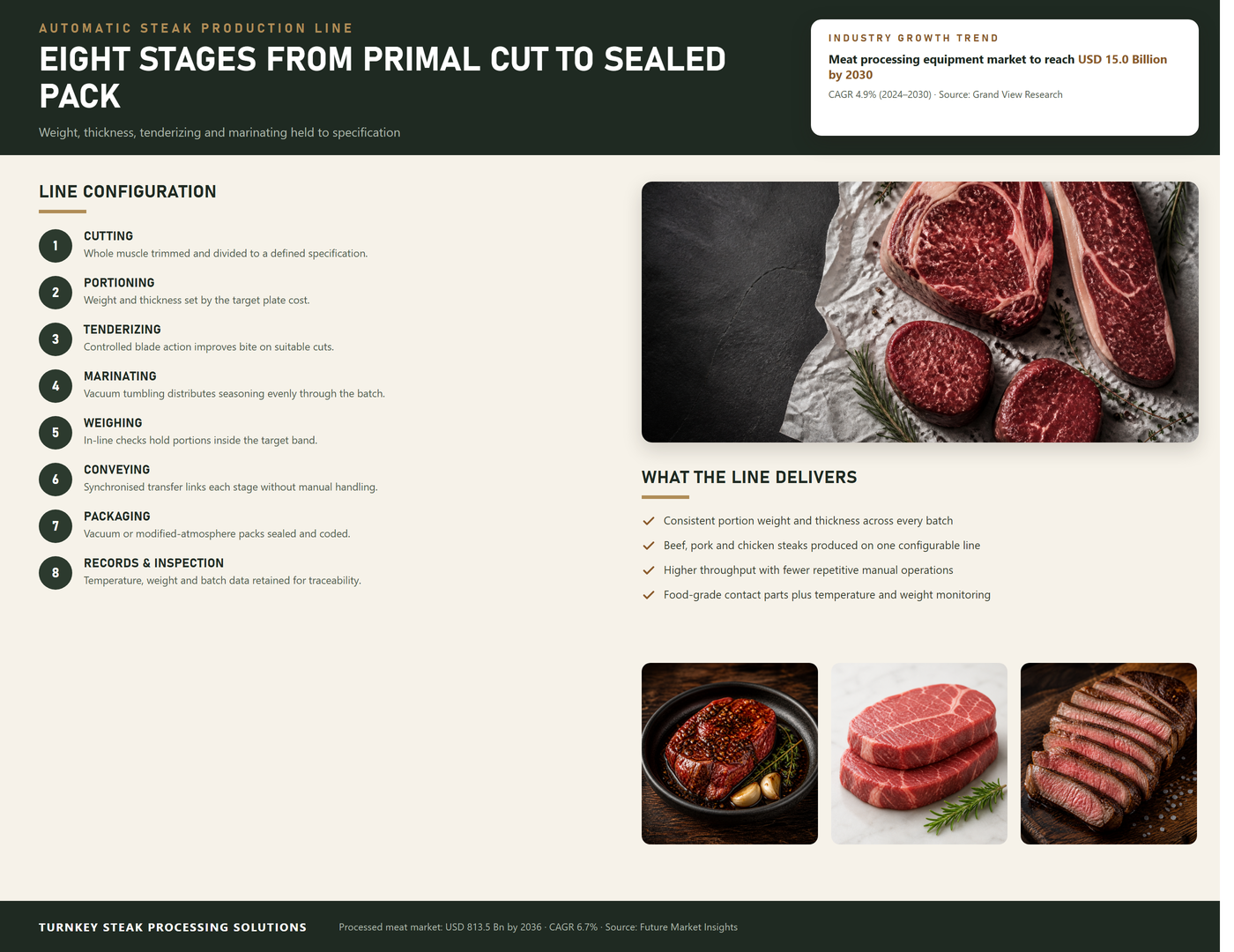
Looking ahead, the steak processing industry is increasingly influenced by smart manufacturing, resource efficiency, flexible production, and data-driven quality management. Machine vision and AI-assisted inspection are attracting attention across meat processing because they can support product assessment, process monitoring, and yield optimization in suitable applications. Recent industry developments have demonstrated how computer vision can help beef processors identify additional recoverable meat and improve resource utilization, highlighting the potential value of data-supported processing decisions.Although these technologies may not be necessary for every steak factory, they illustrate a broader movement toward measurable production performance and more intelligent equipment integration. A modern steak production line can be designed with PLC control, touchscreen operation, adjustable processing parameters, automatic weighing, and optional inspection or production data systems according to the project's needs. Manufacturers are also paying closer attention to energy consumption, water use, cleaning efficiency, and raw material waste as part of their long-term operating strategies. Optimized portioning, appropriate equipment sizing, preventive maintenance, and efficient production scheduling can help improve resource utilization without compromising product specifications. Flexible line design is especially valuable for factories serving multiple markets, since beef, pork, and poultry products may require different cutting tools, processing parameters, hygiene procedures, and packaging configurations. When selecting a steak processing line manufacturer, buyers should evaluate cutting accuracy, achievable capacity, compatibility with their raw materials, portion-size requirements, ease of cleaning, maintenance needs, spare parts availability, installation support, and after-sales technical service. It is also important to request processing tests using representative raw materials and to confirm the expected output under clearly defined operating conditions. A customized solution should be based on the complete production process rather than a single machine's advertised capacity. Whether a business is establishing a new steak factory, upgrading an existing meat processing facility, or expanding into marinated and ready-to-cook products, a well-designed automatic steak production line can help improve workflow, maintain more consistent portions, support food safety management, and strengthen production flexibility. By combining appropriate machinery with effective operating procedures and quality controls, meat manufacturers can respond more effectively to changing buyer expectations and build a more competitive position in the global meat processing market.
Mob: +86 15094949111
WhatsApp: +86 15094949111
Skype: +86 15094949111
WeChat: +86 15094949111
Email: caroline@zekomachinery.com