Automatic Steamed Bun Production Line for Commercial Baozi Manufacturing
Automatic Steamed Bun Production Line: Advantages and Future Trends
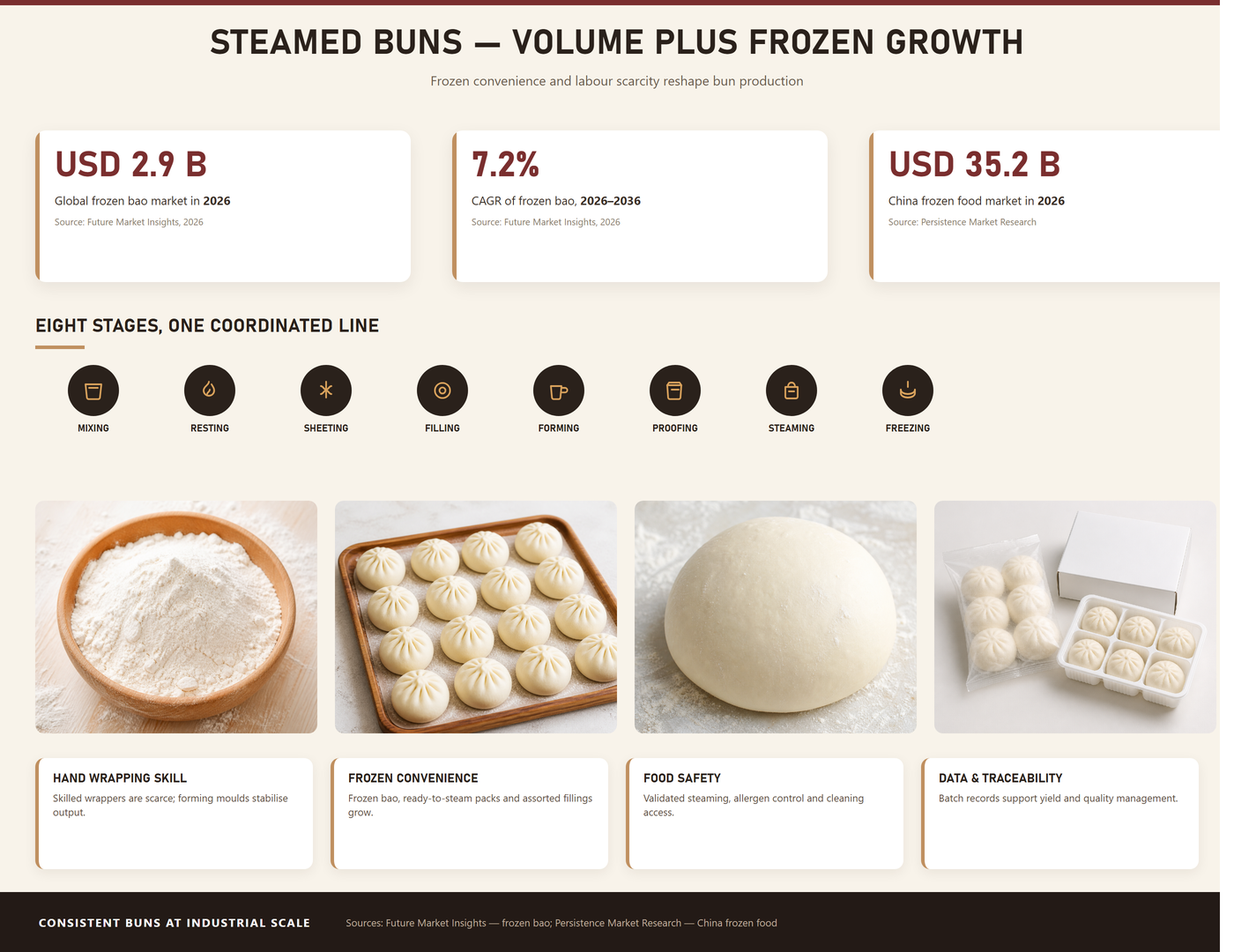
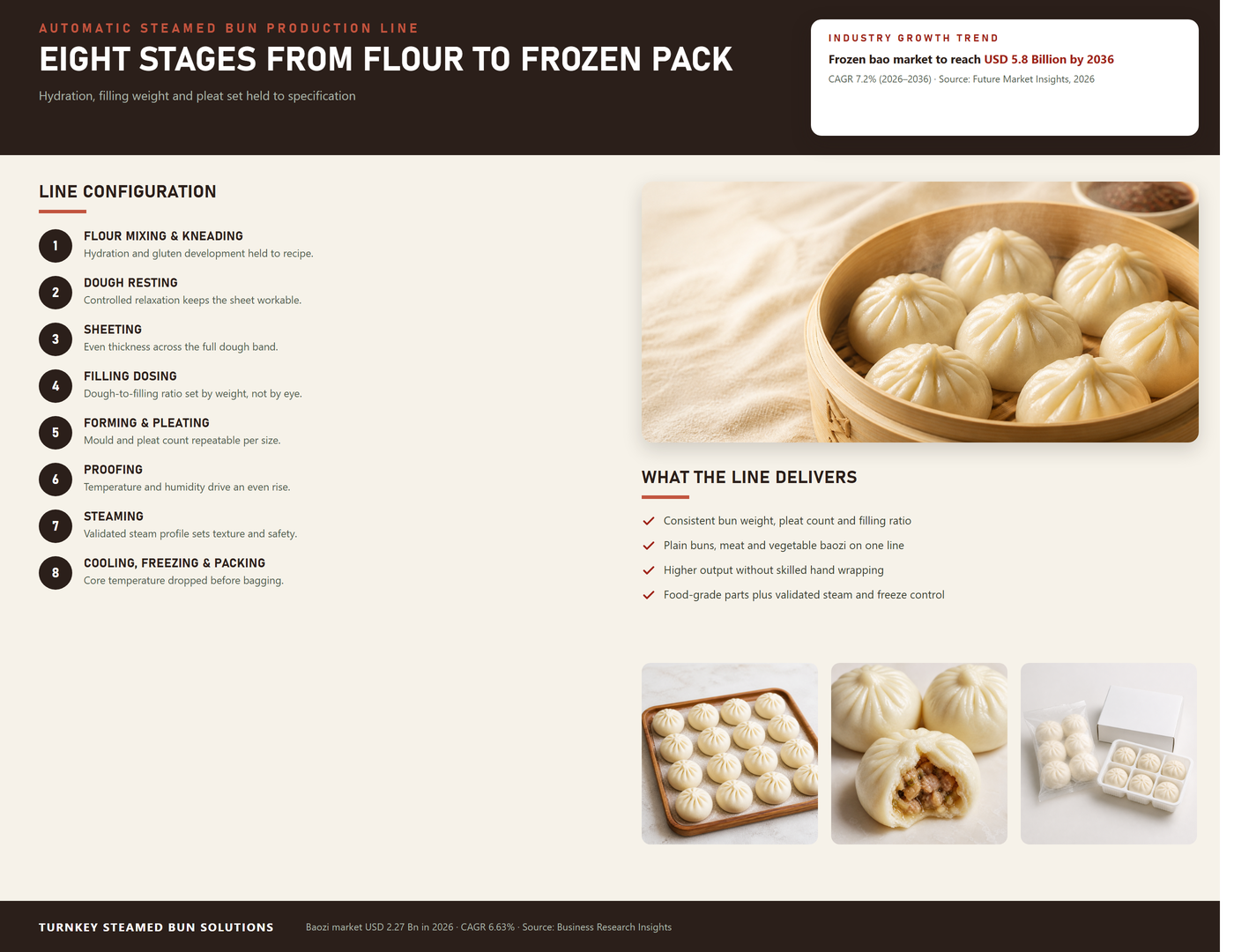
With the growing demand for convenient staple foods, frozen prepared foods, and standardized bakery products, steamed buns are gaining opportunities in supermarkets, restaurants, school cafeterias, hotels, central kitchens, and frozen food distribution networks. Popular products include traditional Chinese steamed buns, meat-filled baozi, vegetable buns, pork buns, beef buns, chicken buns, and frozen ready-to-steam products. As food manufacturers expand their production capacity, they face increasing pressure to maintain consistent dough texture, filling distribution, bun shape, production efficiency, and food safety. An automatic steamed bun production line provides an integrated solution for manufacturers seeking to transform traditional handmade production into a more standardized and scalable process. Depending on the product type and required output, the line can include flour mixing, dough kneading, dough resting, filling preparation, dough sheeting, filling dosing, forming, proofing where required, steaming, cooling, freezing, and packaging equipment. Different configurations can be designed for plain steamed buns, filled baozi, meat buns, vegetable buns, and frozen steamed bun products. By coordinating these operations, manufacturers can reduce repetitive manual work, improve production flow, and support more consistent product specifications. A properly designed baozi manufacturing line also allows businesses to adjust bun size, dough-to-filling ratio, product shape, and packaging format according to customer requirements. For food factories supplying retailers, catering companies, restaurants, and wholesale distributors, this flexibility creates opportunities to expand product varieties and respond to changing consumer preferences. As demand for convenient frozen foods and ready-to-prepare meals continues to influence the food industry, investing in suitable automatic steamed bun processing equipment can help manufacturers increase production capacity and build a more competitive manufacturing operation.
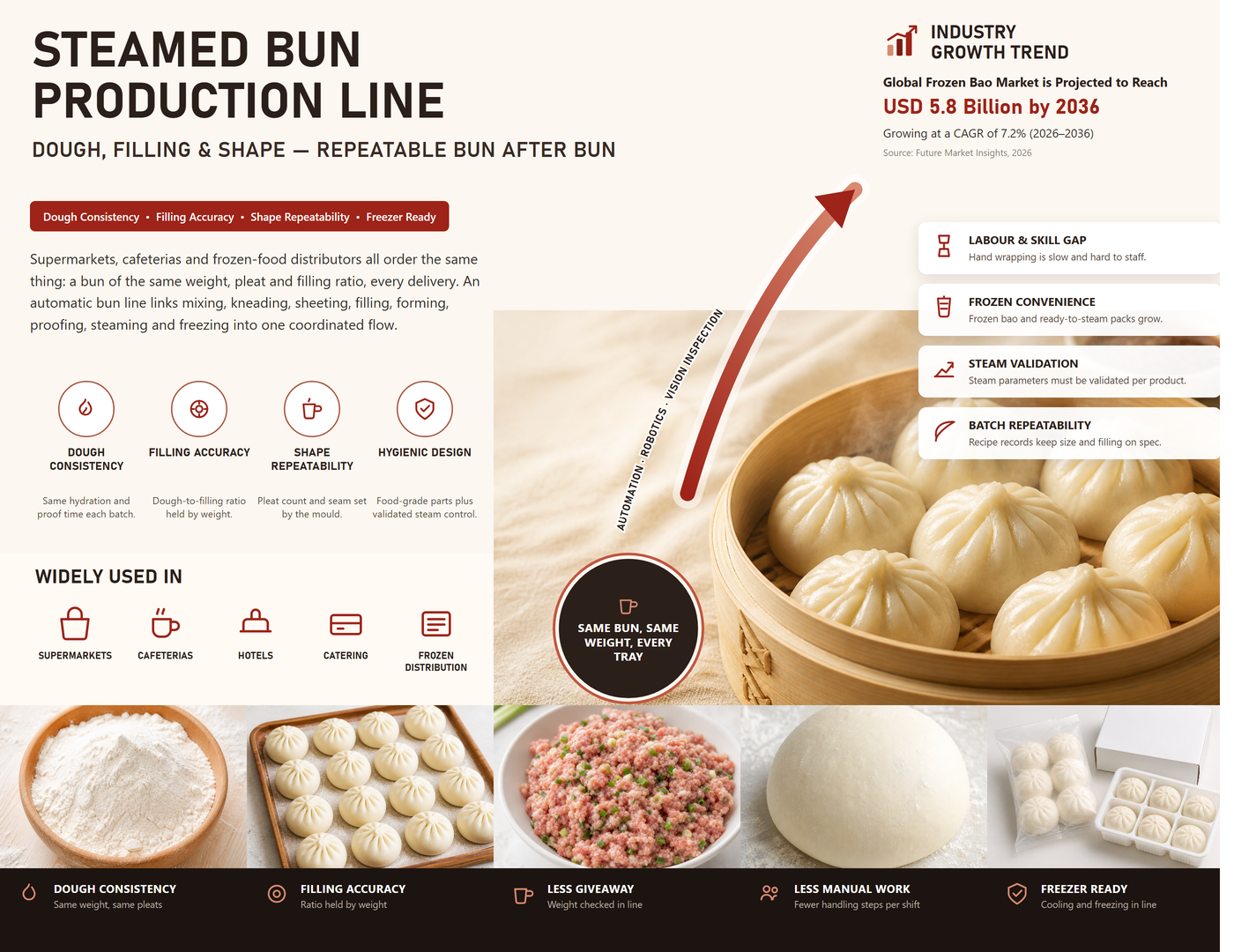
One of the major advantages of an industrial steamed bun production line is its ability to improve production efficiency while maintaining product consistency. In manual production, differences in dough mixing, dough elasticity, filling weight, wrapping technique, and shaping can cause variations in bun size, appearance, texture, and filling distribution. Automated dough mixing and forming equipment can help standardize repetitive operations, while accurate filling systems support more consistent portion control. Suitable forming technology can produce buns with repeatable shapes and sealing quality when recipes and machine settings are properly matched. For filled baozi, the dough and filling systems should be designed to handle the required ingredient characteristics without compromising filling distribution or dough structure. Depending on the product, additional equipment may be needed for vegetable cutting, meat grinding, filling mixing, proofing, steaming, cooling, or freezing. Automated conveying and packaging can further improve workflow and reduce unnecessary product handling. These capabilities may help lower labor requirements, reduce avoidable material waste, and make production scheduling more predictable, although actual output depends on bun size, filling type, recipe, equipment configuration, and operating conditions. Food safety and hygiene are equally important for commercial steamed bun manufacturing. Food-contact components should use suitable materials, and the equipment layout should allow effective cleaning, inspection, and maintenance. Manufacturers need appropriate controls for flour and filling storage, raw meat and vegetable handling, allergen management, cooking conditions, and finished-product protection. Steaming parameters must be established according to product size, filling composition, and validated food safety requirements. If frozen steamed buns are produced, cooling, freezing, packaging, and cold-chain management must be designed to protect product quality and safety. Packaging alone does not guarantee a particular shelf life; formulation, processing, storage temperature, packaging integrity, and validated procedures all influence the final result. Modern production systems can incorporate PLC controls, touchscreen operation, adjustable production parameters, and batch records to improve process repeatability and quality management. By combining suitable equipment with standardized operating procedures, manufacturers can produce more consistent steamed buns while improving production control.
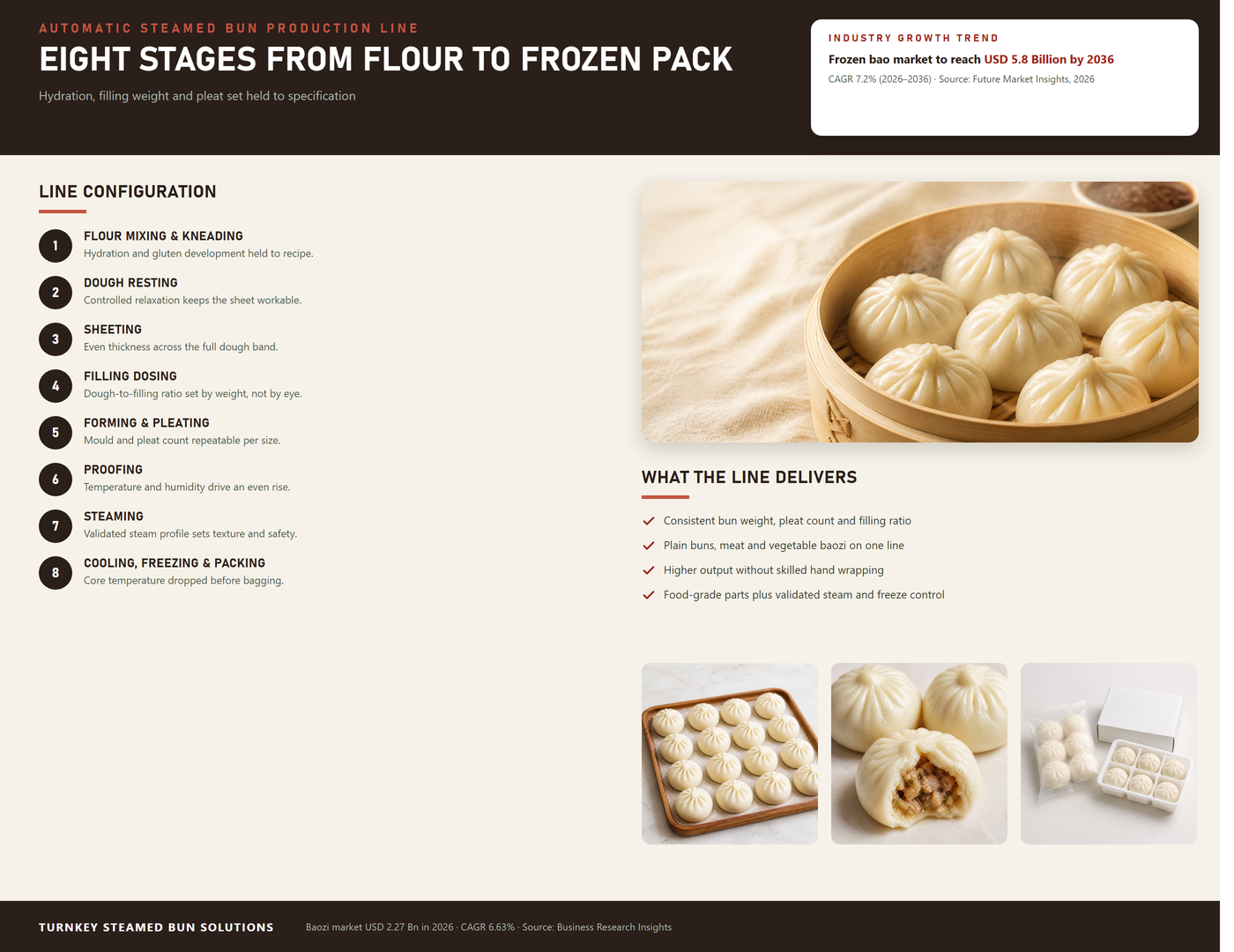
Looking ahead, the steamed bun manufacturing industry is increasingly influenced by automation, frozen food innovation, flexible production, digital monitoring, and resource efficiency. Consumers and foodservice operators value products that are convenient to store, easy to prepare, and consistent in quality, creating opportunities for manufacturers to develop frozen baozi, individually packaged buns, assorted fillings, and products tailored to regional tastes. A modern automatic steamed bun production line can be configured with programmable controls, automatic dough feeding, adjustable filling dosing, recipe management, and optional production data recording. These functions can help operators manage different product specifications and improve batch-to-batch consistency. Flexible forming systems are particularly valuable for factories producing several bun sizes or fillings, while modular equipment allows businesses to expand capacity as demand grows. Energy-efficient steaming equipment, effective insulation, optimized production scheduling, and well-planned cleaning procedures may help reduce operating costs and improve resource utilization. For frozen products, appropriately selected cooling and freezing systems can support efficient downstream processing and help preserve the intended texture when combined with suitable packaging and cold-chain management. Small and medium-sized businesses may benefit from semi-automatic or modular baozi production equipment, while large food factories may require integrated lines connecting dough preparation, filling, forming, steaming, freezing, and packaging. When selecting a steamed bun production line manufacturer, buyers should evaluate production capacity, dough and filling compatibility, bun weight accuracy, forming quality, steaming performance, cleaning accessibility, energy consumption, maintenance requirements, spare parts availability, installation support, and after-sales technical service. It is also important to confirm the expected output using the actual dough recipe, filling ingredients, and target bun size. A well-designed solution should be tailored to the complete production process rather than relying solely on a machine's advertised speed. By investing in suitable automatic steamed bun processing equipment, manufacturers can improve efficiency, maintain consistent product quality, expand their product range, and strengthen their position in the growing global market for convenient staple foods.